

Product & process innovation
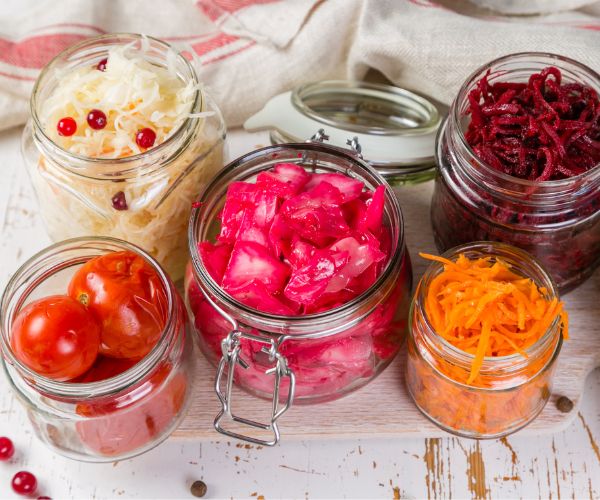
Formulation: how to ferment vegetables?
23
June
Published on : 23/06/2022
The CTCPA, agri-food technical center, is at your service to help you ferment your vegetables!
Did you know that? We offer a training on the key points of fermented vegetable production October 10th and 11th 2022 in Avignon ! Register now: Fermentation training for plant products (ctcpa.org)
Ask for more information from Stella PLANCHON - microbiology project manager -splanchon@ctcpa.org
The CTCPA is :
__
We help you to realize the products of your dreams, taking into account all the important dimensions for manufacture and develop healthy food products : naturalness, formulation under stress, plant protein...products that have taste : preservation of the native qualities of the ingredients, formulation of the taste and colors you want to offer to consumers, obtaining the ideal textures...products in accordance with the environmental values : reduction of the packaging impactof the carbon footprint, characterization by LCA... finally benefit from a improve your product's ranking by reworking them with our teams: NUTRI-SCORE®, SIGA®, and other scales... !
- Create great tasting products with our 70 years of experience in plant-based products and our research programs to optimize processes.
- Secure your development with our core competence in conservation and preservation (production parameters).
- Reassure your customers and the DDPP thanks to the guarantee of an Industrial Technical Center:
- Recognized by the Ministry of Agriculture (General Directorate of Food) as a reference center for the establishment and validation of heat treatment scales Note de service DGAL/SDSSA/N2011-8153.
- Microbiology unit recognized by the DGAL for the realization of growth tests (challenge test) with Listeria monocytogenes (NS of 28/11/2013).
- Microbiology unit recognized by the DGAL to validate microbiological shelf-life files of foodstuffs (IT of 24/12/2019).
Did you know that? We offer a training on the key points of fermented vegetable production October 10th and 11th 2022 in Avignon ! Register now: Fermentation training for plant products (ctcpa.org)
Ask for more information from Stella PLANCHON - microbiology project manager -splanchon@ctcpa.org
The CTCPA is :
- 96 employees with expertise in the food industry, more than 30 research programs per year
- Product / process specialists by category:
- Meat products / Prepared dishes and sauces / Vegetable products (including fermented) / Beverages / Juices / Cereal products
- 4 equipped technological halls : to manufacture models & pre-series
- A plant protein (PV) unit in charge of exploring, testing, characterizing and providing product specialists with the process for using PV
__
We help you to realize the products of your dreams, taking into account all the important dimensions for manufacture and develop healthy food products : naturalness, formulation under stress, plant protein...products that have taste : preservation of the native qualities of the ingredients, formulation of the taste and colors you want to offer to consumers, obtaining the ideal textures...products in accordance with the environmental values : reduction of the packaging impactof the carbon footprint, characterization by LCA... finally benefit from a improve your product's ranking by reworking them with our teams: NUTRI-SCORE®, SIGA®, and other scales... !