


CSR: our approach to
a sustainable food model

In September 2025, the CTCPA was awarded the AFNOR’s “Engagé RSE” certification, with a confirmed level (level 3 out of 4 – 582 points out of 1,000). This certification marks the culmination of several years of structuring our approach and highlights the initiatives already implemented.


The success of this process is attested to by theEngagé RSE certification and governed by the Engagé RSE Charter, which formalizes the CTCPA’s commitments in its environmental, social, and societal strategy. This recognition marks an and and serves as a foundation for ongoing improvement, both in supporting businesses and in the CTCPA’s internal operations.
A sustainable food model
The CTCPA’s CSR approach aims to balance economic performance, environmental responsibility, and social commitment, while actively contributing to a safe, sustainable, and resilient food system. Driven by all teams and implemented across all CTCPA sites and business lines, this approach is based on three key pillars that guide our actions, reinforce our exemplary role, and provide long-term support for the agri-food sector.
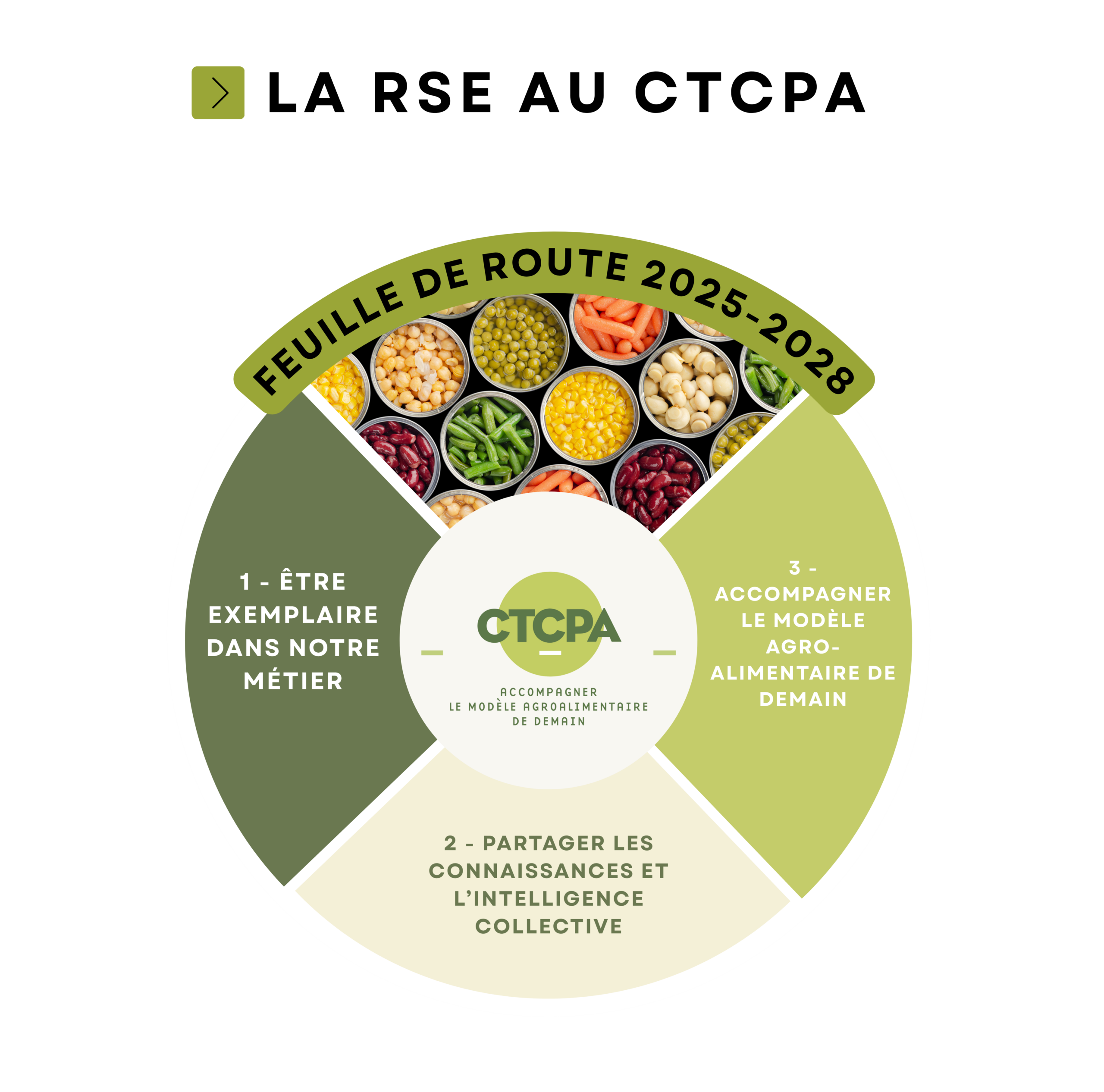


To be a role model in our profession
Setting an example in our field is a fundamental commitment for theCTCPA: creating an environment that fostersemployee growth, safety, andwell-being; ensuring ethical conduct and scientific and technical excellence; and acting responsibly to preserve resources.
Operational commitments
- Reducing the environmental footprint of our operations, in particular by controlling energy consumption, reducing and recycling waste, developing lower-emission transportation options, and strengthening responsible purchasing and investment practices;
- Developing skills, quality of life, and workplace safetyby supporting continuing education,employee well-being, and occupational risk prevention;
- Ensuring ethical standards, reliability, and scientific excellenceby ensuring the rigor and traceability of our work, actively participating in scientific and regulatory bodies, and investing in tools and collaborative research approaches.
Sharing knowledge and fostering collective intelligence
The CTCPA draws on the strength of the collective to sustainably enhance its expertise and impact. Building capacity through internal exchanges, knowledge sharing, and engagement in regional networks and ecosystems are key drivers that benefit the agri-food sector.
Operational commitments
- Create an environment that fosters collaboration, knowledge sharing, and professional development among teams;
- Structure the transfer and promotion of knowledge through mentoring, tutoring, and knowledge-sharing initiatives;
- Strengthen synergies with industry stakeholders, local communities, and professional networks to provide localized technical support and contribute to the collective momentum of the agri-food sector.


Supporting the agri-food model of tomorrow
The CTCPA supports companies in the agri-food sector as they navigate changes in production models, the challenges of the ecological and energy transition, the development of technologies for the industry of the future, and food safety requirements. This focus reflects the CTCPA’s commitment to a resilient, sustainable, and self-sufficient agri-food sector.
Operational commitments
- Supporting the transition of production modelsby helping companies optimize their processes and technological pathways to reduce environmental impacts and integrate the principles of the Reduce – Reuse – Recycle, particularly with regard to packaging;
- Supporting innovation and the industry of the futureby developing tools for measuring product quality, digital solutions, and approaches based on data, real-time monitoring, and predictive tools;
- Strengthening industrial performance and resilienceby supporting the evolution of practices, processes, and skills, and by contributing to the sustainability of the agri-food industrial base;
- Ensuring a high level of health and safetyby improving risk assessment, developing analytical methods, and securing production processes to anticipate crises and ensure reliable production.
Examples of our commitments
The following illustrations provide concrete examples of how the CTCPA’s commitments are reflected in its practices and expertise in support of the agri-food sector.
Environmental challenges at every stage of a product's life cycle
Recognized for its expertise in managing the environmental impacts of food processing, the CTCPA takes a comprehensive approach to environmental issues throughout the entire production process.
This commitment is reflected, in particular, inthe optimization of formulations, processes, and production lines, as well as in efforts to advance food packaging. These efforts incorporate the principles of reduction, recyclability, and reuse, in line with evolving distribution methods.
For more information:Environmental Impact: Evolve Your Production Models


Examples of our commitments
The following illustrations provide concrete examples of how the CTCPA’s commitments are reflected in its practices and expertise in support of the agri-food sector.
Promoting professional equality between women and men
The CTCPA implements management principles designed to ensure fairness among employees, particularly gender equality in the workplace.
For the year 2025, the CTCPA achieved agenderequality indexscore of 93 out of 100, reflecting the institution’s commitment to responsible practices and continuous improvement in these areas.
Examples of our commitments
The following illustrations provide concrete examples of how the CTCPA’s commitments are reflected in its practices and expertise in support of the agri-food sector.
Preserve and pass on the sector's expertise
The CTCPA helps ensure the long-term sustainability of skills in the agri-food sector by offering training programs tailored to changes in the industry and the needs of businesses.
These training programs cover both core technical skills and emerging issues related to the green transition, quality, and the transfer of expertise. Offered in a variety of formats, they are designed to provide long-term support to professionals, from new hires to seasoned managers.