
Partners, sectors & events

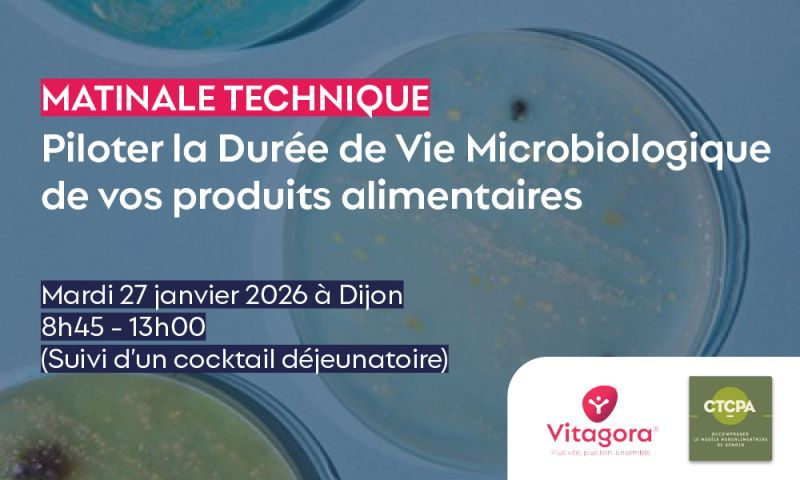
Technical Morning Session – Controlling the Microbiological Shelf Life of Your Food Products

04

Dec
Technical Morning Session – Controlling the Microbiological Shelf Life of Your Food Products

Published on: 12/04/2025

On Tuesday, January 27, 2026, from 8:45 a.m. to 1:00 p.m., the CTCPA and Vitagora are organizing a technical morning dedicated to controlling the microbiological shelf life (MSL) of food products. The event will be held at the Village by CA Champagne Bourgogne in Dijon and will be followed by a cocktail lunch to encourage networking among professionals.


Today, DVM is a major strategic issue for the agri-food industry. It faces several challenges: ensuring food safety, meeting consumer expectations in terms of naturalness, clean labeling, and plant-based products, while also incorporating regulatory changes, particularly those relating to Listeria, nitrite reduction, and storage temperatures.


The objective of this morning session is to provide participants with concrete and directly applicable tools for evaluating, predicting, and controlling the DVM of their products. Discussions will be based on feedback and a practical workshop using real-life cases to facilitate the implementation of the methods presented.


On the program:


  • Regulatory reminders and DVM methodology

  • Available tools: predictive microbiology, challenge tests, metagenomics

  • Strategies and innovations for controlling contamination

  • Practical workshop and group feedback session


This meeting is aimed at professionals who want to strengthen their expertise, secure their products, and anticipate developments in the sector.

Register now here!


Spread the love

latest news

07

Jul

An Update on Clostridium: Current Food Safety Issues

Bacteria of the genus Clostridium pose a major food safety concern due to their ability to form highly resistant spores and, in the case of certain species, to produce toxins that cause foodborne illnesses, some of which can be severe.

Read more

Bacteria of the genus Clostridium pose a major food safety concern due to their ability to form highly resistant spores and, in the case of certain species, to produce toxins that cause foodborne illnesses, some of which can be severe.

07

Jul

From Data to Environmental Labels: The Role of Agribalyse®, InCyVie, and Ecobalyse®

Environmental labeling of food products is set to play an increasingly important role in the strategies of agri-food companies.

Read more

Environmental labeling of food products is set to play an increasingly important role in the strategies of agri-food companies.

07

Jul

NIAS: What Are the Challenges for Food Safety?

Unintentionally Added Substances (UAS) are a growing concern for manufacturers of materials intended to come into contact with food.

Read more

Unintentionally Added Substances (UAS) are a growing concern for manufacturers of materials intended to come into contact with food.

latest news

Regulations, food safety

07

Jul

An Update on Clostridium: Current Food Safety Issues

Posted at 10:03

Bacteria of the genus Clostridium pose a major food safety concern due to their ability to form highly resistant spores and, in the case of certain species, to produce toxins that cause foodborne illnesses, some of which can be severe.

Read more

Industrial and environmental transition

07

Jul

From Data to Environmental Labels: The Role of Agribalyse®, InCyVie, and Ecobalyse®

Posted at 9:40 a.m.

Environmental labeling of food products is set to play an increasingly important role in the strategies of agri-food companies.

Read more

Packaging

07

Jul

NIAS: What Are the Challenges for Food Safety?

Posted at 9:33 a.m.

Unintentionally Added Substances (UAS) are a growing concern for manufacturers of materials intended to come into contact with food.

Read more

This will close in 0 seconds