

Product & process innovation
Innovations in the Pasteurization of Prepared Foods: Microwave Technology at the Service of the Food Industry
05
June
Published on: 05/06/2024
The market for pasteurized ready-made meals in supermarkets has grown strongly in recent years, particularly in the form of tray-packed, ready-to-heat products. The stakes involved in microwave pasteurization are therefore high, with both economic and environmental dimensions. The Centre Technique de la Conservation des Produits Agricoles (CTCPA) has been working for several years with equipment manufacturer SAIREM, a leader in industrial microwave and radio frequency applications since 1978. The aim of their partnership is to develop and improve microwave pasteurization technology, particularly for tray-packed ready meals.
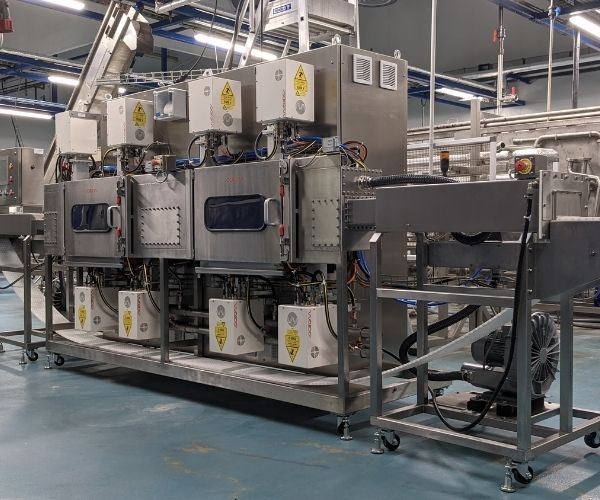
Decarbonation: installation of a SAIREM microwave pasteurization tunnel at the CTCPA
In 2021, on the Avignon site, CTCPA, a specialist in heat treatment, has installed a microwave pasteurization tunnel. SAIREM of the latest generation. This 100% electric technology is in line with the industry's decarbonization strategy, to which the CTCPA is contributing through its research and business support programs.
The 5m-long, 24kW pilot tunnel allows easy modulation of the energy supplied to the product, and control of dwell time by fine-tuning the belt speed. The 8 microwave generators (4 above and 4 below) enable the matrix to be brought up to temperature quickly and evenly, with no loss of energy as it is absorbed directly by the product (no loss to the oven). The technology can pasteurize trays: e.g. 350g continuously in 8 to 15min depending on the matrix.
Our knowledge of the technology enables us to select power and time ranges for very rapid heat-up to temperatures close to 100°C, in order to limit the cooking value and preserve the organoleptic qualities of the product. Conversely, it is possible to offer a gradual rise in temperature, followed by stabilization, to cook a product in its packaging, such as dry pasta with the addition of a sauce. This is one way of reducing the number of pre-cooking steps, etc.
A patented blower system to control package tightness
The main challenge encountered when pasteurizing ready meals is the swelling of the plastic lid as the temperature rises. The air in the headspace expands, and the water vapour produced during heating increases the pressure in the tray. The risk of bursting therefore increases as processing progresses. To achieve this, SAIREM has developed a patented air injection system, close to the trays circulating in the tunnel, which evacuates the heat from the surface of the lid. The air injected locally cools the packaging at the lid. The swelling of the tray is therefore controlled, and the tightness of the packaging can be guaranteed.
Microwaves and cellulosic trays: an alternative to 100% plastic trays
In parallel with tests on plastic trays, tests have also led to a more environmentally-friendly packaging solution, adapted to the process.. In a multi-criteria performance approach, it is indeed important to work on the packaging lever in addition to the energy axis... Cellulosic trays (thermoformed fibers, cardboard, etc.) have been tested and selected, offering an alternative to 100% plastic trays.
Microwave pasteurization: CTCPA supports you in partnership with SAIREM
Microwave technology is now a viable heat treatment and pasteurization solution for SLEDs ranging from a few days to around 60 days, depending on the recipe. This is done with air in the tray. This saves you having to add gas. The CTCPA works in partnership with SAIREM to develop your pasteurized products. This support is generally broken down into 3 stages, including product testing and behavior under microwave treatment. The organoleptic quality of the products and the integrity of the packaging are assessed. This is followed by a second pre-production phase, followed by a challenge test phase to determine the decontamination efficiency of the treatment.
In short, it is now possible to microwave tray-packed products at temperatures approaching 100°C, considerably broadening the range of applications. But that's not all!
Microwave treatment of products in trays at sterilization temperatures: a CIFRE thesis by CTCPA and ONIRIS/GEPEA
Going further SAIREM, CTCPA and ONIRIS/GEPEA have launched a CIFRE thesis as part of a project aimed at making microwave treatment of products in trays possible at sterilization temperatures; an ambitious course to meet the challenges of process electrification and energy efficiency.
Contact : contact@ctcpa.org
_
Article written by Mathéo BENAS - Technology Project Manager