

Industrial and environmental transition
[New training course] Reducing food waste in the agri-food industry
10
Jul
![[New training course] Reducing food waste in the agri-food industry](https://www.ctcpa.org/wp-content/uploads/2023/04/SITE-Image-article-3.jpg)
Published on: 10/07/2023
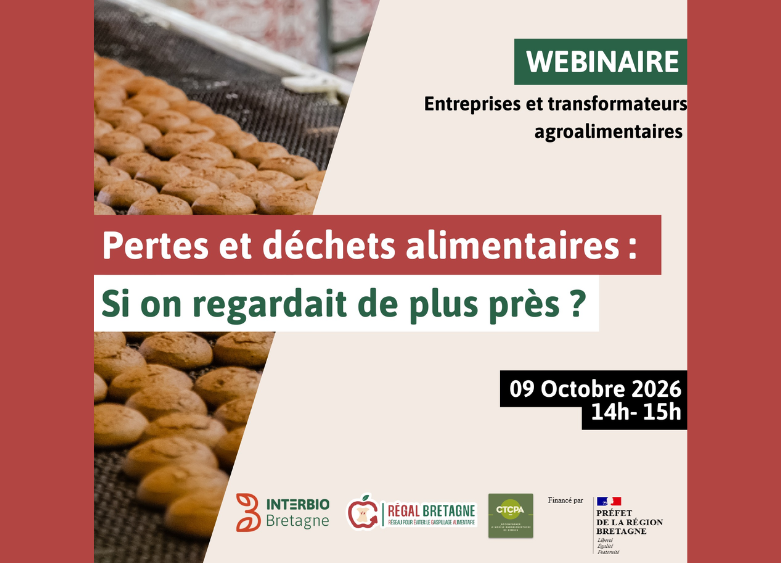
Do you want to reduce your environmental impact? Do you want to anticipate regulations and obtain a future label? The CTCPA has pooled its expertise in food quality/safety and sustainable development to offer you a comprehensive training program to help you contribute to a more sustainable world. The aim of this training course is to support food processors from the diagnosis of food losses and waste to the action plan, based on the Adepale/CTCPA guide.
Date October 19, 2023 - distance learning Available in-house from November 2023
More info : Online training - Acting on food waste in the agri-food industries - CTCPA.ORG
More on the guide : Diagnostic guide to food loss and waste (ctcpa.org)
Combating food waste at every link in the chain is an important lever in the transition to a more sustainable food system. The French anti-waste law for a circular economy (Loi anti-gaspillage pour une économie circulaire - AGEC) sets the following national targets: a 50% reduction in waste by 2024 in the areas of food distribution and collective catering, and 2030 in the areas of consumption, production, processing and commercial catering. In order to mobilize and promote the players in the food chain who contribute to the national objectives, the national anti-waste label for distribution was introduced in March 2023, and work is now beginning on the label for catering. Work on the label for processing will follow by 2025.
Contact Valérie LE GOUEFF - contact.formation@ctcpa.org – 01 53 91 44 01
Date October 19, 2023 - distance learning Available in-house from November 2023
More info : Online training - Acting on food waste in the agri-food industries - CTCPA.ORG
More on the guide : Diagnostic guide to food loss and waste (ctcpa.org)
Combating food waste at every link in the chain is an important lever in the transition to a more sustainable food system. The French anti-waste law for a circular economy (Loi anti-gaspillage pour une économie circulaire - AGEC) sets the following national targets: a 50% reduction in waste by 2024 in the areas of food distribution and collective catering, and 2030 in the areas of consumption, production, processing and commercial catering. In order to mobilize and promote the players in the food chain who contribute to the national objectives, the national anti-waste label for distribution was introduced in March 2023, and work is now beginning on the label for catering. Work on the label for processing will follow by 2025.
Contact Valérie LE GOUEFF - contact.formation@ctcpa.org – 01 53 91 44 01