Packaging

Packaging innovation: a support tool for packaging manufacturers and users

04

Feb
Packaging innovation: a support tool for packaging manufacturers and users

Published on : 04/02/2022

A packaging innovation tool for packaging manufacturers and users has been developed in the framework of the European project Mypack, coordinated by Actia and in connection with the RMT Actia Propack food. The CTCPA has ensured the scientific coordination of the tool design.


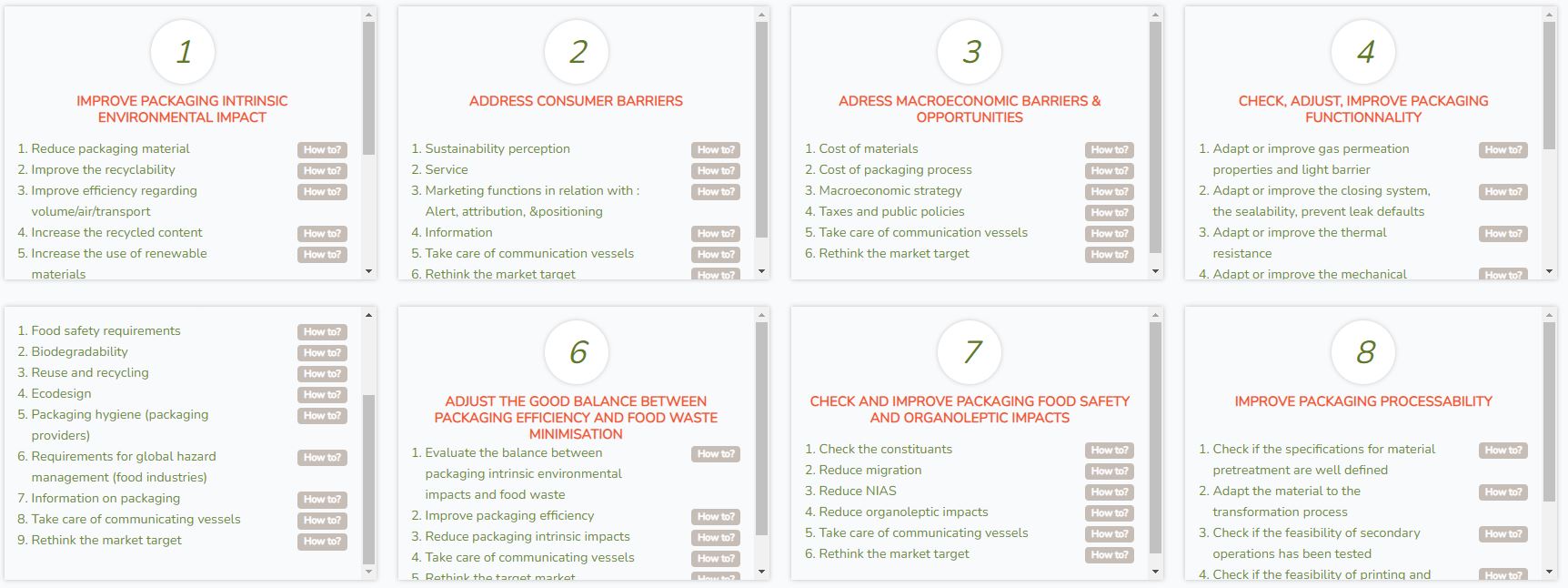
L'tool The packaging innovation support system, developed within the framework of the European project Mypack, addresses all the barriers to market access for packaging technologies:

  • the proper functionality of the packaging,

  • compliance with regulatory constraints,

  • industrial feasibility,

  • control of the environmental impact of packaging,

  • control of contaminant migration,

  • economic constraints,

  • consumer acceptability.


mypack tool

Each section can be addressed separately. Innovation always starts from one of these points of view, and therefore rarely embraces them exhaustively. But at the end of each chapter we invite the user to consider the other constraints. In the subsection "Beware of communicating vessels", we make the user aware of the negative impacts of a "monomaniacal" optimization. For example, if the innovation is carried out only from the point of view of the intrinsic environmental impacts of the packaging, it will be important to consider that the decrease in functionality also has consequences on the conservation performance and its impacts on food waste.

The CTCPA ensured the scientific coordination of the project as well as the design of the tool.
The tool is built to be evolutionary; it will be regularly updated and enriched with links to more detailed documents.

Contact: David Allain, Director of the Bourg en Bresse center (CTCPA) - dallain@ctcpa.org
Contact CTCPA Emballages : bourg@ctcpa.org

__

The CTCPA helps you to optimize your food packaging solutions.
Spread the love

latest news

07

Jul

An Update on Clostridium: Current Food Safety Issues

Bacteria of the genus Clostridium pose a major food safety concern due to their ability to form highly resistant spores and, in the case of certain species, to produce toxins that cause foodborne illnesses, some of which can be severe.

Read more

Bacteria of the genus Clostridium pose a major food safety concern due to their ability to form highly resistant spores and, in the case of certain species, to produce toxins that cause foodborne illnesses, some of which can be severe.

07

Jul

From Data to Environmental Labels: The Role of Agribalyse®, InCyVie, and Ecobalyse®

Environmental labeling of food products is set to play an increasingly important role in the strategies of agri-food companies.

Read more

Environmental labeling of food products is set to play an increasingly important role in the strategies of agri-food companies.

07

Jul

NIAS: What Are the Challenges for Food Safety?

Unintentionally Added Substances (UAS) are a growing concern for manufacturers of materials intended to come into contact with food.

Read more

Unintentionally Added Substances (UAS) are a growing concern for manufacturers of materials intended to come into contact with food.

latest news

Regulations, food safety

07

Jul

An Update on Clostridium: Current Food Safety Issues

Posted at 10:03

Bacteria of the genus Clostridium pose a major food safety concern due to their ability to form highly resistant spores and, in the case of certain species, to produce toxins that cause foodborne illnesses, some of which can be severe.

Read more

Industrial and environmental transition

07

Jul

From Data to Environmental Labels: The Role of Agribalyse®, InCyVie, and Ecobalyse®

Posted at 9:40 a.m.

Environmental labeling of food products is set to play an increasingly important role in the strategies of agri-food companies.

Read more

Packaging

07

Jul

NIAS: What Are the Challenges for Food Safety?

Posted at 9:33 a.m.

Unintentionally Added Substances (UAS) are a growing concern for manufacturers of materials intended to come into contact with food.

Read more

This will close in 0 seconds