


Customer testimonials
Biscuit Factory: The CTCPA is supporting the socially responsible biscuit factory Le Beau Geste in the industrial-scale production of sweet and savory organic biscuit recipes made with legumes!
30
Mar
Published on: March 30, 2026
The CTCPA is supporting the socially responsible bakery Le Beau Geste in scaling up production of sweet and savory organic cookie recipes made with legumes. We spoke with Fleur Masson, the founder.
“The support provided by the CTCPA was both technical and personal: the training made concepts I was completely unfamiliar with accessible and allowed me to envision myself working in cookie production.”
Tell us about LE BEAU GESTE: its structure, vision, values, products…
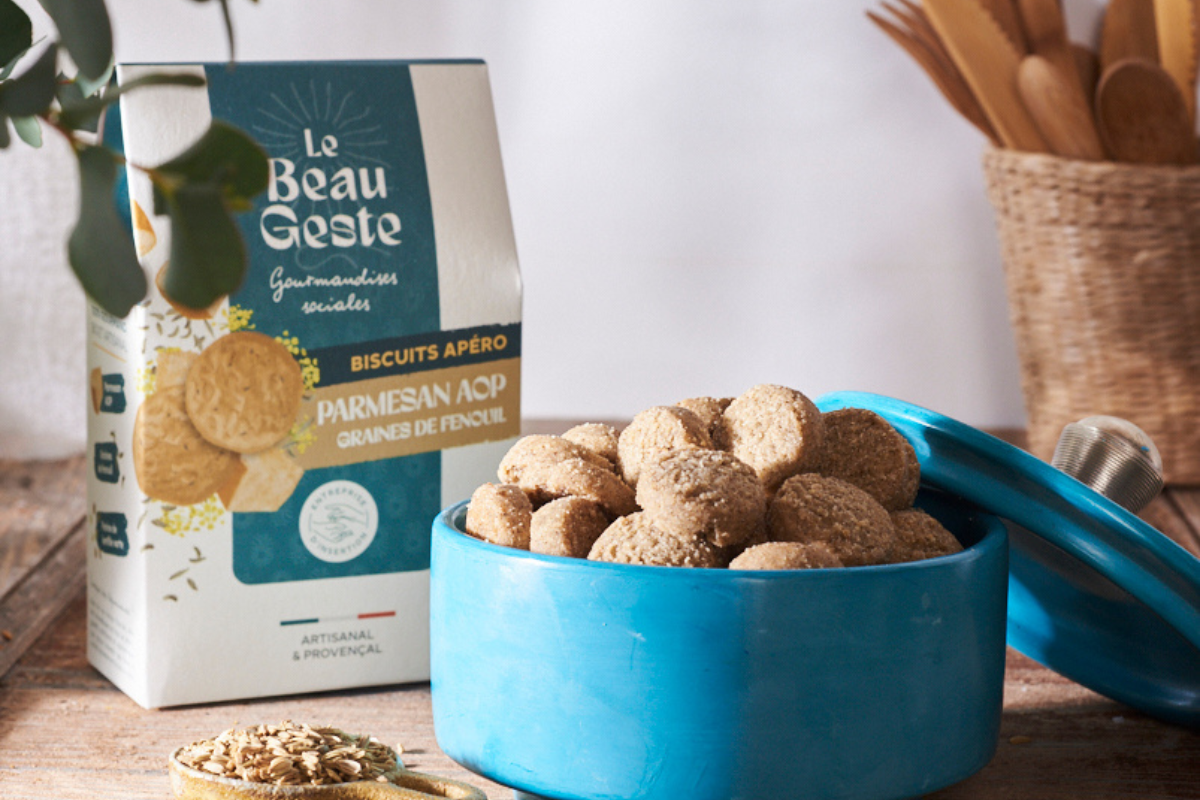
Le Beau Geste is an organic, artisanal, and socially responsible cookie company founded in 2022 in Le Thor, near L’Isle-sur-la-Sorgue, in the Vaucluse department. The company is guided by a dual mission.
The first is to produce high-quality organic cookies, both sweet and savory, some of which are made with legume flours. Exceptional taste is at the heart of what we do.
Our second mission is social: Beau Geste is a state-certified social integration enterprise. We recruit and train people who are far from the job market under integration contracts lasting up to 24 months. They receive support both professionally—to develop their skills and regain confidence—and socially—to define a career path and access the necessary training. The company thus aims to serve as a true springboard to employment.
Balancing product excellence with our social mission is a daily challenge. With our teams changing regularly, we must continuously pass on our expertise to maintain high standards of quality—both in terms of taste and compliance with health regulations and HACCP procedures.
We have our own workshop, equipped for semi-industrial production, and distribute our products to organic stores, grocery stores, businesses, and individuals.
This commitment has been recognized on numerous occasions. In particular, our cookies have been awarded the 2025 Best Organic Product prize in the cookie category, as well as a Golden Epicure award for our orange blossom recipe. These accolades demonstrate that it is possible to combine a strong social commitment with culinary excellence.
How did you come to contact the CTCPA? What were your needs? What were your objectives?
We consulted with the CTCPA at several key stages of the project.
The first, in 2021, before the company was founded, was a one-week training course at the CTCPA in Avignon. It allowed me to learn the basics of cookie production: manufacturing principles, quality and food safety issues (HACCP), and equipment knowledge. This was essential for structuring my project and selecting the right machinery, particularly for recipes based on legumes.
The second support initiative, in 2022, was part of the Innovagro program, funded by the South Region through the CRITT Agroalimentaire PACA. The CRITT coordinated the project, while Marie Luce LEBRIQUER, CTCPA’s Cereal Project Manager, provided technical support.
By that point, I already had artisanal recipes developed in collaboration with a Michelin-starred pastry chef. The goal was to adapt them for semi-industrial production: formulation, ingredient sourcing, kneading time, dough texture, baking… Thanks to the CTCPA’s expertise, we were able to finalize six key recipes that served as the foundation for launching the business.
Why did you choose the CTCPA? How did you hear about the CTCPA?
I was already familiar with the CTCPA’s reputation through my professional network. When I decided to start my own cookie business, I was looking for an organization that could provide practical support during the launch phase—both to train me in production techniques and to help structure the recipe development process. The CTCPA quickly established itself as the go-to choice, thanks to its comprehensive technical expertise and in-depth knowledge of the cookie industry. Their support seemed to me to be the best way to move from concept to production while ensuring the strategic and technical decisions for my project were sound.
How did the support go?
The first mentoring session, as part of the training program at the CTCPA in Avignon, took place over the course of a week with a small group of about half a dozen project leaders from diverse backgrounds. The training combined theoretical instruction with hands-on workshops, and participants had access to the technology hall and certain production machines.
This step was crucial in shaping my project. It allowed me to understand industrial processes, identify the right machinery, and clarify the technical challenges, particularly for recipes based on legumes. Hands-on experience with equipment, such as the filling machine, was essential for making informed decisions and beginning to organize my future workshop, in an industry where observing existing practices is difficult due to competition.
The second support initiative, in 2022, was part of the Innovagro program. We established a rigorous organizational structure, with regular communication and a structured methodology, to carry out the R&D phase step by step: testing, analysis, and adjustments to production parameters. The CTCPA’s expertise was invaluable in defining test protocols, optimizing formulations, and ensuring the soundness of technical decisions, all while adhering to time and budget constraints.
Beyond technical support, this guidance provides a methodological framework and a sense of security for the project—both of which are essential for a startup facing financial and strategic challenges. It is also based on a relationship of trust, with the CTCPA offering its expertise and industry knowledge while ensuring the confidentiality of each company’s proprietary information.
What is your assessment today? How do you see the benefits of this support?
The support provided by the CTCPA was essential in taking the business from concept to reality. It allowed me to start with a solid foundation of six recipes and to organize production right from the launch. Thanks to this step, I was able to acquire the technical and methodological skills needed to organize production and move forward with confidence.
Since then, we have come a long way: some recipes have been tweaked, new ones have been created, and we have implemented a process of continuous improvement based on consumer feedback and our day-to-day operations. With time and experience, we have since gained greater autonomy. Today, we handle adjustments to existing recipes and the development of new ones in-house, always with a focus on continuous improvement. We take consumer feedback and production constraints into account to optimize taste, texture, and industrial processes, while maintaining the quality and consistency of our product line.
Our expertise remains focused on dry cookies, a field in which we have developed significant expertise. However, if we wish to develop a new type of product—such as madeleines, waffles, or other formats requiring different production processes—we will once again turn to the CTCPA to benefit from their expertise and methodology.
What are your next goals or announcements?
Today, our main priorities focus primarily on optimizing our operations. The goal is to continue increasing our production volumes while working to reduce our manufacturing costs, as margins and production efficiency are key priorities for us this year. We are therefore focusing more on optimization and continuous improvement.
We also continue to participate in trade shows, which are part of our annual sales plan, including key events for us such as Natexpo and Terroirs en fête.
In addition, we are preparing to launch a new product: a cookie made with wheat flour, hazelnuts, and milk chocolate. This is a major milestone for us, as it is our first 100% wheat-based recipe, designed first and foremost to be a treat. We have deliberately set aside legumes to offer a cookie that evokes childhood memories and is very generous in size.
The recipe was first tested in a small batch at Christmas with Biocoop Le Thor, where it was very well received. We therefore decided to officially launch it with custom packaging, which has also been updated. The design has been revamped, and we continue to highlight our social commitment through the packaging, particularly with illustrations that tell the stories of employees’ paths to integration within the company.
This new product is expected to arrive soon and is part of our ongoing commitment to refining our recipes and improving our products, both in terms of taste and presentation.
Note: This interview was conducted in January 2026. The Le Beau Geste cookie factory ceased operations in March 2026. We nevertheless wanted to share this account, which reflects the support provided by the CTCPA and the economic realities that this type of project may face. We extend our full support to its founder and wish her all the best for the future.
__
Fleur MASSON, Founder: fleur@lebeaugeste.fr
LinkedIn: (30) Le Beau Geste: Overview | LinkedIn
Website: Le Beau Geste | A Socially Responsible Bakery
CONTACT CTCPA :
Marie Luce LEBRIQUER, Cereal Project Manager: mlebriquer@ctcpa.org
For all other inquiries : contact@ctcpa.org or 01 53 91 44 08
For more information: https://www.ctcpa.org/
“The support provided by the CTCPA was both technical and personal: the training made concepts I was completely unfamiliar with accessible and allowed me to envision myself working in cookie production.”
Tell us about LE BEAU GESTE: its structure, vision, values, products…
Le Beau Geste is an organic, artisanal, and socially responsible cookie company founded in 2022 in Le Thor, near L’Isle-sur-la-Sorgue, in the Vaucluse department. The company is guided by a dual mission.
The first is to produce high-quality organic cookies, both sweet and savory, some of which are made with legume flours. Exceptional taste is at the heart of what we do.
Our second mission is social: Beau Geste is a state-certified social integration enterprise. We recruit and train people who are far from the job market under integration contracts lasting up to 24 months. They receive support both professionally—to develop their skills and regain confidence—and socially—to define a career path and access the necessary training. The company thus aims to serve as a true springboard to employment.
Balancing product excellence with our social mission is a daily challenge. With our teams changing regularly, we must continuously pass on our expertise to maintain high standards of quality—both in terms of taste and compliance with health regulations and HACCP procedures.
We have our own workshop, equipped for semi-industrial production, and distribute our products to organic stores, grocery stores, businesses, and individuals.
This commitment has been recognized on numerous occasions. In particular, our cookies have been awarded the 2025 Best Organic Product prize in the cookie category, as well as a Golden Epicure award for our orange blossom recipe. These accolades demonstrate that it is possible to combine a strong social commitment with culinary excellence.
How did you come to contact the CTCPA? What were your needs? What were your objectives?
We consulted with the CTCPA at several key stages of the project.
The first, in 2021, before the company was founded, was a one-week training course at the CTCPA in Avignon. It allowed me to learn the basics of cookie production: manufacturing principles, quality and food safety issues (HACCP), and equipment knowledge. This was essential for structuring my project and selecting the right machinery, particularly for recipes based on legumes.
The second support initiative, in 2022, was part of the Innovagro program, funded by the South Region through the CRITT Agroalimentaire PACA. The CRITT coordinated the project, while Marie Luce LEBRIQUER, CTCPA’s Cereal Project Manager, provided technical support.
By that point, I already had artisanal recipes developed in collaboration with a Michelin-starred pastry chef. The goal was to adapt them for semi-industrial production: formulation, ingredient sourcing, kneading time, dough texture, baking… Thanks to the CTCPA’s expertise, we were able to finalize six key recipes that served as the foundation for launching the business.
Why did you choose the CTCPA? How did you hear about the CTCPA?
I was already familiar with the CTCPA’s reputation through my professional network. When I decided to start my own cookie business, I was looking for an organization that could provide practical support during the launch phase—both to train me in production techniques and to help structure the recipe development process. The CTCPA quickly established itself as the go-to choice, thanks to its comprehensive technical expertise and in-depth knowledge of the cookie industry. Their support seemed to me to be the best way to move from concept to production while ensuring the strategic and technical decisions for my project were sound.
How did the support go?
The first mentoring session, as part of the training program at the CTCPA in Avignon, took place over the course of a week with a small group of about half a dozen project leaders from diverse backgrounds. The training combined theoretical instruction with hands-on workshops, and participants had access to the technology hall and certain production machines.
This step was crucial in shaping my project. It allowed me to understand industrial processes, identify the right machinery, and clarify the technical challenges, particularly for recipes based on legumes. Hands-on experience with equipment, such as the filling machine, was essential for making informed decisions and beginning to organize my future workshop, in an industry where observing existing practices is difficult due to competition.
The second support initiative, in 2022, was part of the Innovagro program. We established a rigorous organizational structure, with regular communication and a structured methodology, to carry out the R&D phase step by step: testing, analysis, and adjustments to production parameters. The CTCPA’s expertise was invaluable in defining test protocols, optimizing formulations, and ensuring the soundness of technical decisions, all while adhering to time and budget constraints.
Beyond technical support, this guidance provides a methodological framework and a sense of security for the project—both of which are essential for a startup facing financial and strategic challenges. It is also based on a relationship of trust, with the CTCPA offering its expertise and industry knowledge while ensuring the confidentiality of each company’s proprietary information.
What is your assessment today? How do you see the benefits of this support?
The support provided by the CTCPA was essential in taking the business from concept to reality. It allowed me to start with a solid foundation of six recipes and to organize production right from the launch. Thanks to this step, I was able to acquire the technical and methodological skills needed to organize production and move forward with confidence.
Since then, we have come a long way: some recipes have been tweaked, new ones have been created, and we have implemented a process of continuous improvement based on consumer feedback and our day-to-day operations. With time and experience, we have since gained greater autonomy. Today, we handle adjustments to existing recipes and the development of new ones in-house, always with a focus on continuous improvement. We take consumer feedback and production constraints into account to optimize taste, texture, and industrial processes, while maintaining the quality and consistency of our product line.
Our expertise remains focused on dry cookies, a field in which we have developed significant expertise. However, if we wish to develop a new type of product—such as madeleines, waffles, or other formats requiring different production processes—we will once again turn to the CTCPA to benefit from their expertise and methodology.
What are your next goals or announcements?
Today, our main priorities focus primarily on optimizing our operations. The goal is to continue increasing our production volumes while working to reduce our manufacturing costs, as margins and production efficiency are key priorities for us this year. We are therefore focusing more on optimization and continuous improvement.
We also continue to participate in trade shows, which are part of our annual sales plan, including key events for us such as Natexpo and Terroirs en fête.
In addition, we are preparing to launch a new product: a cookie made with wheat flour, hazelnuts, and milk chocolate. This is a major milestone for us, as it is our first 100% wheat-based recipe, designed first and foremost to be a treat. We have deliberately set aside legumes to offer a cookie that evokes childhood memories and is very generous in size.
The recipe was first tested in a small batch at Christmas with Biocoop Le Thor, where it was very well received. We therefore decided to officially launch it with custom packaging, which has also been updated. The design has been revamped, and we continue to highlight our social commitment through the packaging, particularly with illustrations that tell the stories of employees’ paths to integration within the company.
This new product is expected to arrive soon and is part of our ongoing commitment to refining our recipes and improving our products, both in terms of taste and presentation.
Note: This interview was conducted in January 2026. The Le Beau Geste cookie factory ceased operations in March 2026. We nevertheless wanted to share this account, which reflects the support provided by the CTCPA and the economic realities that this type of project may face. We extend our full support to its founder and wish her all the best for the future.
__
CONTACT THE BEAUTIFUL GESTURE:
Fleur MASSON, Founder: fleur@lebeaugeste.fr
LinkedIn: (30) Le Beau Geste: Overview | LinkedIn
Website: Le Beau Geste | A Socially Responsible Bakery
CONTACT CTCPA :
Marie Luce LEBRIQUER, Cereal Project Manager: mlebriquer@ctcpa.org
For all other inquiries : contact@ctcpa.org or 01 53 91 44 08
For more information: https://www.ctcpa.org/