

Customer testimonials
Innovation: CTCPA supports start-up SEA4EARTH in developing innovative seaweed sheets for the food industry
16
Feb
Published on: February 16, 2026
The CTCPA supported the start-up SEA4EARTH in developing innovative seaweed sheets for the food industry. We look back with Nicolas DURAND, Co-founder & President of Sea4Earth.
"We are very satisfied with the support provided by CTCPA! Their technical expertise and the human quality of their support have created essential mutual trust. Today, this relationship allows us to move forward effectively, week after week, on our projects."
Tell us about SEA4EARTH: structure, vision, values, products, etc.
Before talking directly about the brand, we need to briefly return to the origins of the project, because Sea4Earth was born out of an observation made in the field. I have spent a large part of my career in the agri-food industry, in France but mainly in Asia, which has allowed me to observe both the structure of the sectors and their current limitations. The conclusion is clear: our food models will not be able to meet the challenges ahead—a rapidly growing global population, plateauing agricultural yields, depleted soils, and an increasingly constrained climate.
At the same time, the sea remains largely overlooked as a source of food. Today, only 2% of our calorie intake comes from the sea, mainly through fish and shellfish, even though these resources are overexploited. Seaweed, despite being extremely rich in nutrients, has been largely forgotten. In Asia, it is part of everyday life; in Europe, the industry remains largely unstructured.
Sea4Earth was born out of this dual observation. We identified a major imbalance in the value chain: seaweed producers struggle to sell their products, while processors and marketers face supply difficulties. Until this chain is organized in a coherent manner, the market cannot truly develop. Our vision is therefore to take an integrated approach to seaweed, from cultivation to valorization, with an industrial approach, while leaving an essential place for artisanal models at the local level.
We have chosen to focus on human nutrition. On the one hand, because it is a matter of sovereignty and resilience: in times of crisis, we always continue to eat. On the other hand, because seaweed is a superfood that can enrich everyday products without disrupting consumption habits. The goal is not to force consumers to eat algae, but to intelligently integrate it into foods they already know, in order to improve their nutritional quality and environmental impact.
Sea4Earth is fully committed to this food transition: developing a more plant-based, sustainable diet that is better connected to marine ecosystems, and contributing to the construction of a new agri-food model capable of meeting the challenges of the coming decades.
Regarding Sea4Earth's structure, its headquarters are now located in Prado, Marseille. Sea4Earth Méditerranée is leading the Ferme 4.0 project and the work carried out with the CTCPA in Avignon. Sea4Earth Atlantique, based in Nantes, is dedicated to shellfish farming and the use of algae as ingredients, particularly for applications such as ravioli.
Finally, we have created K-Food Connect, a subsidiary dedicated to the import—and eventually export—of Korean products (K-Food and K-Beauty). This activity allows us to generate revenue and penetrate distribution networks, thereby facilitating the future launch of our own products, such as sushi sheets and other seaweed-based applications.
How did you come to contact the CTCPA? What were your needs? What were your objectives?
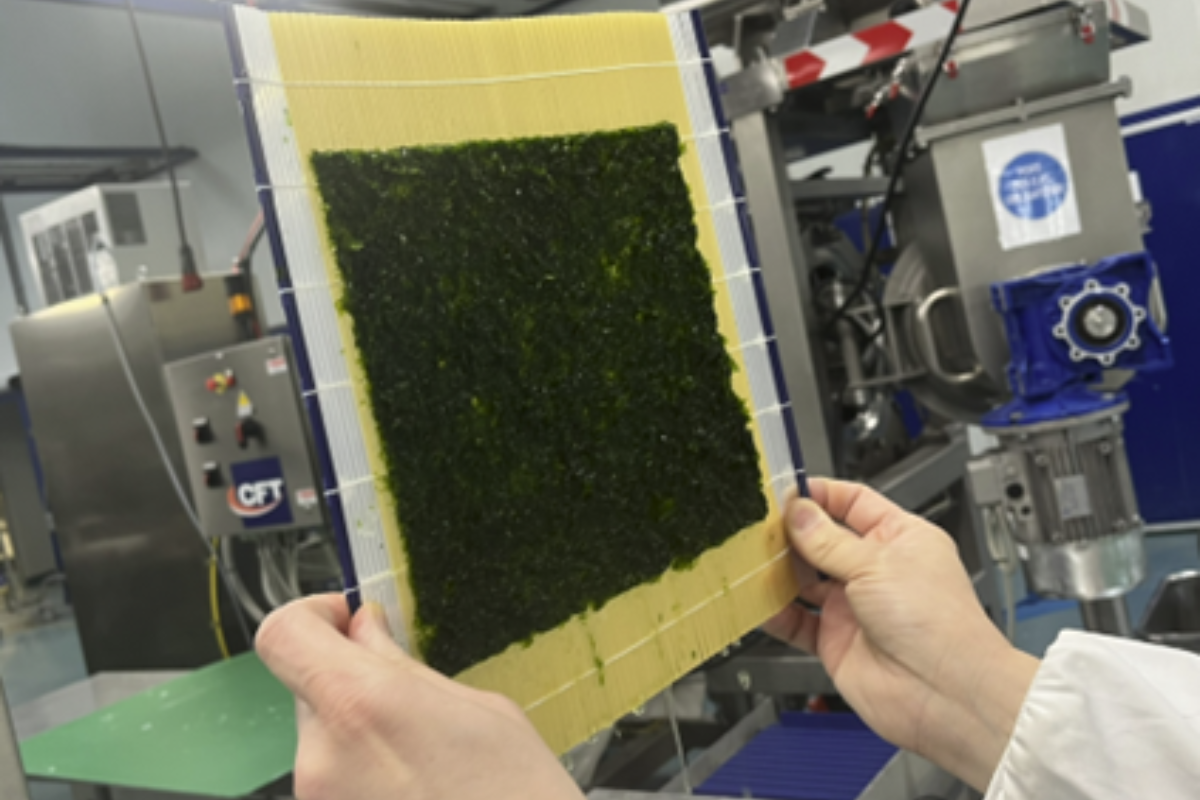
We called on the CTCPA because we were looking for a partner capable of working on the industrial feasibility of producing sushi sheets using something other than nori. When I told Koreans that we wanted to use a different type of seaweed, the look on their faces was a bit like asking a baker to make baguettes without flour! But that's precisely what made it an interesting challenge. We started with ulva, a green seaweed, and even that wasn't easy: we had to obtain a solid sheet with the right thickness that wouldn't break.
At first, we started out in a very artisanal way, by hand, with homemade buckets to pour the seaweed-water mixture and dry it on mats. It was DIY, but it proved that it was possible. Then we needed an industrial pilot. Korean machines are designed for large volumes, five thousand tons of seaweed over 160 days, whereas in France we only cultivate a fraction of that. So we worked with our Korean partners to identify the key elements of these machines, purchase certain components, and build a suitable test bench in France, with the help of the CTCPA.
The CTCPA enabled us to move from this artisanal pilot project to an industrial test bench that is unique in Europe. Today, it is installed in Avignon and we use it to test and optimize recipes: water quantity, additives, algae preparation, temperature, etc. Each algae reacts differently, and it is much more complex than nori. With the CTCPA and local technicians, we are learning to master this process and are moving forward step by step to develop several types of innovative sheets, remaining faithful to traditional methods but adapted to new seaweeds.
Why did you choose the CTCPA? How did you hear about the CTCPA?
Like any start-up, we first compared what was already available. The CTCPA quickly became an attractive option for several reasons. First, its proximity to co-founder Régis LEFÈBVRE, based in Manosque, which facilitates coordination. Second, the location: our first algae cultivation pilot project is in Cadarache, in the south, and it made sense for the recovery pilot project to be nearby to facilitate monitoring and communication.
Once this initial selection had been made, we contacted the CTCPA and met with the management team in Avignon to discuss how things would work. We immediately sensed their flexibility and their ability to work with us to build a highly specific industrial project, without resorting to standard methods. This collaborative and pragmatic approach was exactly what we were looking for.
Finally, the human factor was decisive: we quickly established excellent relationships with the local teams. Their technical expertise and the human quality of their support created essential mutual trust. Today, this relationship allows us to move forward efficiently, week after week, on our projects.
How did the support go?
We are very satisfied with the support provided by CTCPA! The proof is that we are continuing to work with them and the project is still ongoing, which is a very good sign.
There are two aspects: technical and human. On the technical side, the CTCPA does not have specific knowledge about algae, so we are the ones providing the information. But their technicians' experience allows them to translate this information into production processes for our sushi sheets. It's really a collaborative effort: it's not like preservation tests, where they already have hundreds of experiments under their belt. Here, everything is built together.
This week, our tests are being conducted by two members of our team and a technician from CTCPA, three hours a day. The rest we do ourselves, but always with their equipment and expertise. We have moved from the stage of conducting manual tests together to a stage where we are gradually becoming independent, while still working within the CTCPA framework. If we have any questions or need a machine, everything is there.
And then there is the human aspect: with Fabien AUPY and Jean-Claude DUSSAUD, there is genuine trust. We have been working with the CTCPA in this way for over a year now, and I believe that this joint project will be a success for us, but also for them. If we succeed in industrializing these seaweed sheets, the CTCPA's expertise in seaweed valorization will be highlighted and attract new projects and customers.
What are your next goals or announcements?
We have multiple goals ahead of us. We are going to start producing seaweed ravioli and will soon have our first sushi sheets. In terms of events, we will be attending the next Snack Show in Paris in June to test the market with our products and show that seaweed is gaining ground in the food industry.
At the same time, we continue to seek funding to support development, because the economic situation in France is complicated and, in order to move forward, we need to invest and believe in the project. Our goal is to develop an integrated model—farm and processing—that can be replicated and adapted to each region, with modular farms that are connected and optimized for water quality and crop yields.
We are also working on a platform that will pool costs, harvesting systems, and data via artificial intelligence to optimize production and provide alerts on water quality or cultivation parameters. This will enable us to train new players, modernize shellfish farming, and show that seaweed can be an impactful project that appeals to young people.
__
CONTACT SEA4EARTH:
"We are very satisfied with the support provided by CTCPA! Their technical expertise and the human quality of their support have created essential mutual trust. Today, this relationship allows us to move forward effectively, week after week, on our projects."
Tell us about SEA4EARTH: structure, vision, values, products, etc.
Before talking directly about the brand, we need to briefly return to the origins of the project, because Sea4Earth was born out of an observation made in the field. I have spent a large part of my career in the agri-food industry, in France but mainly in Asia, which has allowed me to observe both the structure of the sectors and their current limitations. The conclusion is clear: our food models will not be able to meet the challenges ahead—a rapidly growing global population, plateauing agricultural yields, depleted soils, and an increasingly constrained climate.
At the same time, the sea remains largely overlooked as a source of food. Today, only 2% of our calorie intake comes from the sea, mainly through fish and shellfish, even though these resources are overexploited. Seaweed, despite being extremely rich in nutrients, has been largely forgotten. In Asia, it is part of everyday life; in Europe, the industry remains largely unstructured.
Sea4Earth was born out of this dual observation. We identified a major imbalance in the value chain: seaweed producers struggle to sell their products, while processors and marketers face supply difficulties. Until this chain is organized in a coherent manner, the market cannot truly develop. Our vision is therefore to take an integrated approach to seaweed, from cultivation to valorization, with an industrial approach, while leaving an essential place for artisanal models at the local level.
We have chosen to focus on human nutrition. On the one hand, because it is a matter of sovereignty and resilience: in times of crisis, we always continue to eat. On the other hand, because seaweed is a superfood that can enrich everyday products without disrupting consumption habits. The goal is not to force consumers to eat algae, but to intelligently integrate it into foods they already know, in order to improve their nutritional quality and environmental impact.
Sea4Earth is fully committed to this food transition: developing a more plant-based, sustainable diet that is better connected to marine ecosystems, and contributing to the construction of a new agri-food model capable of meeting the challenges of the coming decades.
Regarding Sea4Earth's structure, its headquarters are now located in Prado, Marseille. Sea4Earth Méditerranée is leading the Ferme 4.0 project and the work carried out with the CTCPA in Avignon. Sea4Earth Atlantique, based in Nantes, is dedicated to shellfish farming and the use of algae as ingredients, particularly for applications such as ravioli.
Finally, we have created K-Food Connect, a subsidiary dedicated to the import—and eventually export—of Korean products (K-Food and K-Beauty). This activity allows us to generate revenue and penetrate distribution networks, thereby facilitating the future launch of our own products, such as sushi sheets and other seaweed-based applications.
How did you come to contact the CTCPA? What were your needs? What were your objectives?
We called on the CTCPA because we were looking for a partner capable of working on the industrial feasibility of producing sushi sheets using something other than nori. When I told Koreans that we wanted to use a different type of seaweed, the look on their faces was a bit like asking a baker to make baguettes without flour! But that's precisely what made it an interesting challenge. We started with ulva, a green seaweed, and even that wasn't easy: we had to obtain a solid sheet with the right thickness that wouldn't break.
At first, we started out in a very artisanal way, by hand, with homemade buckets to pour the seaweed-water mixture and dry it on mats. It was DIY, but it proved that it was possible. Then we needed an industrial pilot. Korean machines are designed for large volumes, five thousand tons of seaweed over 160 days, whereas in France we only cultivate a fraction of that. So we worked with our Korean partners to identify the key elements of these machines, purchase certain components, and build a suitable test bench in France, with the help of the CTCPA.
The CTCPA enabled us to move from this artisanal pilot project to an industrial test bench that is unique in Europe. Today, it is installed in Avignon and we use it to test and optimize recipes: water quantity, additives, algae preparation, temperature, etc. Each algae reacts differently, and it is much more complex than nori. With the CTCPA and local technicians, we are learning to master this process and are moving forward step by step to develop several types of innovative sheets, remaining faithful to traditional methods but adapted to new seaweeds.
Why did you choose the CTCPA? How did you hear about the CTCPA?
Like any start-up, we first compared what was already available. The CTCPA quickly became an attractive option for several reasons. First, its proximity to co-founder Régis LEFÈBVRE, based in Manosque, which facilitates coordination. Second, the location: our first algae cultivation pilot project is in Cadarache, in the south, and it made sense for the recovery pilot project to be nearby to facilitate monitoring and communication.
Once this initial selection had been made, we contacted the CTCPA and met with the management team in Avignon to discuss how things would work. We immediately sensed their flexibility and their ability to work with us to build a highly specific industrial project, without resorting to standard methods. This collaborative and pragmatic approach was exactly what we were looking for.
Finally, the human factor was decisive: we quickly established excellent relationships with the local teams. Their technical expertise and the human quality of their support created essential mutual trust. Today, this relationship allows us to move forward efficiently, week after week, on our projects.
How did the support go?
We are very satisfied with the support provided by CTCPA! The proof is that we are continuing to work with them and the project is still ongoing, which is a very good sign.
There are two aspects: technical and human. On the technical side, the CTCPA does not have specific knowledge about algae, so we are the ones providing the information. But their technicians' experience allows them to translate this information into production processes for our sushi sheets. It's really a collaborative effort: it's not like preservation tests, where they already have hundreds of experiments under their belt. Here, everything is built together.
This week, our tests are being conducted by two members of our team and a technician from CTCPA, three hours a day. The rest we do ourselves, but always with their equipment and expertise. We have moved from the stage of conducting manual tests together to a stage where we are gradually becoming independent, while still working within the CTCPA framework. If we have any questions or need a machine, everything is there.
And then there is the human aspect: with Fabien AUPY and Jean-Claude DUSSAUD, there is genuine trust. We have been working with the CTCPA in this way for over a year now, and I believe that this joint project will be a success for us, but also for them. If we succeed in industrializing these seaweed sheets, the CTCPA's expertise in seaweed valorization will be highlighted and attract new projects and customers.
What are your next goals or announcements?
We have multiple goals ahead of us. We are going to start producing seaweed ravioli and will soon have our first sushi sheets. In terms of events, we will be attending the next Snack Show in Paris in June to test the market with our products and show that seaweed is gaining ground in the food industry.
At the same time, we continue to seek funding to support development, because the economic situation in France is complicated and, in order to move forward, we need to invest and believe in the project. Our goal is to develop an integrated model—farm and processing—that can be replicated and adapted to each region, with modular farms that are connected and optimized for water quality and crop yields.
We are also working on a platform that will pool costs, harvesting systems, and data via artificial intelligence to optimize production and provide alerts on water quality or cultivation parameters. This will enable us to train new players, modernize shellfish farming, and show that seaweed can be an impactful project that appeals to young people.
__