
Life of the CTCPA

RMTs at the heart of agri-food innovation for the next five years

09

Feb
RMTs at the heart of agri-food innovation for the next five years

Published on: February 9, 2026

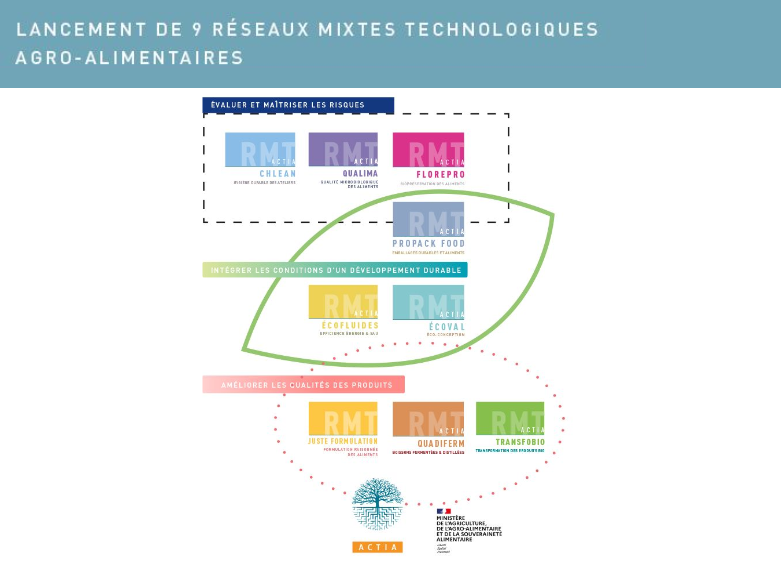
The Ministry of Agriculture and Food Sovereignty recently approved nine mixed technology networks (RMTs) in the agri-food sector for a period of five years starting in January 2026, following an evaluation process based on the opinions of the ACTIA Scientific and Technical Council, the technical institutes for the agri-food sector, which coordinates the process for the agri-food sector.

As a committed player in agri-food innovation, the CTCPA is involved in several of these RMTs, either as a leader or co-leader, focusing on major issues for the sectors:

CHLEAN – Sustainable workshop hygiene (CTCPA)


ECOFLUIDS – Energy & Water Efficiency (CTCPA)


ECOVAL – Eco-design (CTCPA & ITERG)


FLOREPRO – Biopreservation of food (ADIV)


JUSTE FORMULATION – Reasoned food formulation (ADRIA, ADRIANOR & CRITT AGRO ALIMENTAIRE – LA ROCHELLE)


QUADIFERM – Fermented and distilled beverages (IFPC & IFV)


- QUALIMA – Microbiological quality of food (ACTALIA & AERIAL-CRT)

PROPACK FOOD – Sustainable packaging and food (CTCPA & LNE)


TRANSFOBIO – Processing of organic products (CRITT AGROALIMENTAIRE SUD & ITAB)

These RMTs are structured scientific and technical partnerships that promote synergies between research, development, and training, enabling scientific findings to be transformed into concrete solutions for agri-food companies.

A big thank you to all the partners, organizations, and individuals involved in this collective effort.


More information here!

Spread the love

latest news

07

Jul

An Update on Clostridium: Current Food Safety Issues

Bacteria of the genus Clostridium pose a major food safety concern due to their ability to form highly resistant spores and, in the case of certain species, to produce toxins that cause foodborne illnesses, some of which can be severe.

Read more

Bacteria of the genus Clostridium pose a major food safety concern due to their ability to form highly resistant spores and, in the case of certain species, to produce toxins that cause foodborne illnesses, some of which can be severe.

07

Jul

From Data to Environmental Labels: The Role of Agribalyse®, InCyVie, and Ecobalyse®

Environmental labeling of food products is set to play an increasingly important role in the strategies of agri-food companies.

Read more

Environmental labeling of food products is set to play an increasingly important role in the strategies of agri-food companies.

07

Jul

NIAS: What Are the Challenges for Food Safety?

Unintentionally Added Substances (UAS) are a growing concern for manufacturers of materials intended to come into contact with food.

Read more

Unintentionally Added Substances (UAS) are a growing concern for manufacturers of materials intended to come into contact with food.

latest news

Regulations, food safety

07

Jul

An Update on Clostridium: Current Food Safety Issues

Posted at 10:03

Bacteria of the genus Clostridium pose a major food safety concern due to their ability to form highly resistant spores and, in the case of certain species, to produce toxins that cause foodborne illnesses, some of which can be severe.

Read more

Industrial and environmental transition

07

Jul

From Data to Environmental Labels: The Role of Agribalyse®, InCyVie, and Ecobalyse®

Posted at 9:40 a.m.

Environmental labeling of food products is set to play an increasingly important role in the strategies of agri-food companies.

Read more

Packaging

07

Jul

NIAS: What Are the Challenges for Food Safety?

Posted at 9:33 a.m.

Unintentionally Added Substances (UAS) are a growing concern for manufacturers of materials intended to come into contact with food.

Read more

This will close in 0 seconds