

Customer testimonials
Training courses : The CTCPA supports RAF Bocaux in developing its canning and biscuit-making expertise
01
Dec
Published on: 01/12/2025
The CTCPA has supported RAF BOCAUX in the development of its canning and biscuit-making expertise, with two training courses. Raphaël MAGNENET, Founder of RAF BOCAUX, takes a look back.
"These training courses have given us confidence, method and rigor, while enabling us to make concrete progress in mastering our products and processes."
Introduce us to RAF Bocaux: structure, vision, values, products...
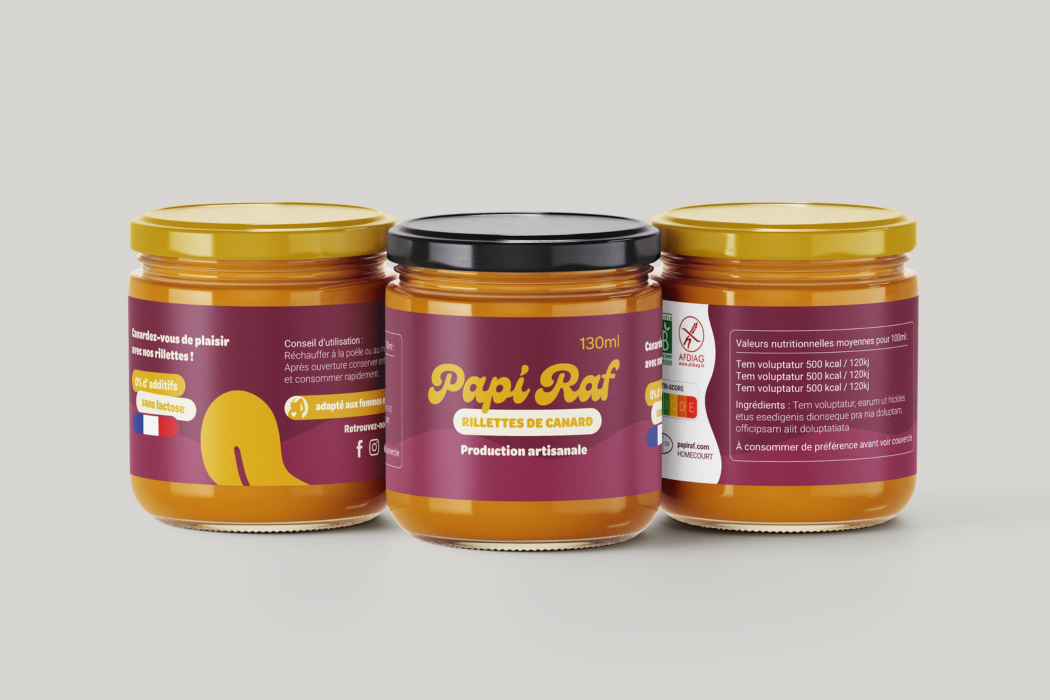
RAF Bocaux, whose brand name is Les Recettes de Papi Raf, is a family business located in Homécourt, Meurthe-et-Moselle (54) in the Grand Est region of France, created as part of a professional reconversion. The company is legally constituted and the trademark registered, but the business has not yet started up to allow for a well thought-out and gradual organization.
We currently have two finalized recipes: rillettes and hazelnut terrines, autoclaved to ensure their preservation. Other recipes, particularly vegetal ones such as pumpkin or carrot spreads, are currently being developed. The company's product range mainly covers canning and biscuit-making, with ready-to-use, gourmet, high-quality products.
Our values and vision are based on gluten-free products, certified by AFDIAG (Association Française Des Intolérants Au Gluten), and additive-free, made from local ingredients and respectful of the environment and animal welfare. Each recipe is designed in collaboration with a dietician-nutritionist to guarantee optimal nutritional balance. We also give priority to the seasonal nature of our ingredients, so that we can offer products that follow the natural rhythm of the harvest and retain all their freshness and flavor.
The aim is to offer a healthy, gourmet alternative that lets you "cook like at home", with easy-to-heat, tasty dishes.
How did you come to contact the CTCPA? What were your needs? What were your objectives?
I turned to the CTCPA as part of my professional retraining. After more than 30 years in project management in the catering trade, I was looking for an activity in the food industry that would enable me to work with my family without the constraints of a restaurant owner, in particular the management of raw materials and the risk of waste.
We've always enjoyed cooking simple, high-quality dishes as a family, and it was important to us to offer gourmet products made with care. The cannery seemed to me to be an interesting solution: we can make products at our own pace, and reduce the pressure of daily production.
The aim was also to find a balance between work and personal life, by reducing travel and working hours, and to be able to work with our daughters on a family project.
While exploring the regulations governing canned foods, I came across the CTCPA, renowned for its training and expertise in the field. After a few initial contacts, I was quickly put in touch with Carla LUCET, with whom exchanges were efficient and responsive. The CTCPA proved to be the ideal partner to benefit from training and technical advice to secure the launch of our business.
Why did you choose the CTCPA? How did you hear about the CTCPA?
I chose the CTCPA for its specific expertise in the canning industry. The answers to my questions were always precise and to the point, enabling me to tackle quite specific technical aspects with complete confidence. Compared with other structures I had contacted, where the information seemed more general, the CTCPA really stood out for the quality of its advice and its practical approach, which convinced me to work with you.
How did the support go?
The support we received from the CTCPA was very positive overall. I took the "Running a canning business" course with Carla and the "Developing a cookie production business" course with Gilles BERTHEAU and Marie-Luce LEBRIQUER. Both courses were very well organized, with a clear framework that allowed me to concentrate on the lessons without worrying about practical organization.
The strong points were the quality of the trainers, their kindness, generosity and sharing of experience. Gilles, for example, was very precise in explaining risks and good practices, and passed on his knowledge in a concrete and accessible way. On the Biscuitier course, everything was very practical and directly applicable.
For the Canner training course, the practical part was limited to one day, allowing me to immerse myself in the skin of a future artisan canner by making a cooked dish under real conditions and familiarizing myself with the use of an autoclave, without becoming immediately autonomous. Having said that, it gave me a solid grounding and enabled me to carry out my own tests and tables to determine the appropriate times and temperatures for different products and containers.
The hygiene, regulations and labeling aspect was particularly enriching, even for someone already familiar with food industry standards. All in all, the training was highly structured and professional, with efficient organization and top-notch pedagogical support, enabling us to know exactly what equipment to buy and how to prepare our products for canning.
What is your assessment today? How do you see the benefits of this support?
My assessment of the CTCPA's support is very positive, in both the canning and biscuit-making areas.
For the cannery, the training reassured us a lot. Before, we were reluctant to take the plunge, fearing the risks associated with sterilization and botulism. Thanks to the training we've received, we've understood that everything depends on strict adherence to protocols and production stages. As long as you follow good practices, there's no danger. This apprenticeship has really enabled us to approach production with peace of mind, and to raise our standards in terms of regulations and labelling.
On the biscuit-making side, I particularly appreciated the research and development method passed on during the training course. We've adopted it for our own trials: we now use a tracking table inspired by the CTCPA's, which enables us to test several recipes in parallel and analyze the results in a structured way. This has completely changed our way of working and innovating.
In short, these training courses have given us confidence, method and rigor, while enabling us to make concrete progress in mastering our products and processes.
What are your next goals or announcements?
Today, our next objectives are to relaunch the production project, but in a more gradual form than we had initially planned. We did not obtain all the funding we had hoped for, which has led us to rethink our model. Rather than immediately setting up our own workshop, we plan to collaborate with existing production halls in our vicinity.
In particular, we have identified several structures: some are equipped with semi-industrial equipment, others are more artisanal, but all offer interesting opportunities for sharing. The idea would be to be able, depending on the situation, to have our recipes produced by these workshops, or to manufacture them ourselves, according to constraints and needs.
Before taking the plunge, we need to clarify a number of points - notably the regulatory, insurance and hygiene aspects, as producing on premises that don't belong to us involves some special procedures. So we're going to get in touch with the relevant departments to make sure everything is done by the book.
Finally, among our next steps, we also plan to launch a crowdfunding campaign on Ulule, whose seriousness we appreciate, especially since the platform collaborates with the CTCPA. This campaign will mark a new phase in the project, more relaxed, but still ambitious.
We are moving forward step by step, with the aim of building a solid, controlled and sustainable model, while remaining true to our artisanal values.
__
CONTACT RAF BOCAUX :
"These training courses have given us confidence, method and rigor, while enabling us to make concrete progress in mastering our products and processes."
Introduce us to RAF Bocaux: structure, vision, values, products...
RAF Bocaux, whose brand name is Les Recettes de Papi Raf, is a family business located in Homécourt, Meurthe-et-Moselle (54) in the Grand Est region of France, created as part of a professional reconversion. The company is legally constituted and the trademark registered, but the business has not yet started up to allow for a well thought-out and gradual organization.
We currently have two finalized recipes: rillettes and hazelnut terrines, autoclaved to ensure their preservation. Other recipes, particularly vegetal ones such as pumpkin or carrot spreads, are currently being developed. The company's product range mainly covers canning and biscuit-making, with ready-to-use, gourmet, high-quality products.
Our values and vision are based on gluten-free products, certified by AFDIAG (Association Française Des Intolérants Au Gluten), and additive-free, made from local ingredients and respectful of the environment and animal welfare. Each recipe is designed in collaboration with a dietician-nutritionist to guarantee optimal nutritional balance. We also give priority to the seasonal nature of our ingredients, so that we can offer products that follow the natural rhythm of the harvest and retain all their freshness and flavor.
The aim is to offer a healthy, gourmet alternative that lets you "cook like at home", with easy-to-heat, tasty dishes.
How did you come to contact the CTCPA? What were your needs? What were your objectives?
I turned to the CTCPA as part of my professional retraining. After more than 30 years in project management in the catering trade, I was looking for an activity in the food industry that would enable me to work with my family without the constraints of a restaurant owner, in particular the management of raw materials and the risk of waste.
We've always enjoyed cooking simple, high-quality dishes as a family, and it was important to us to offer gourmet products made with care. The cannery seemed to me to be an interesting solution: we can make products at our own pace, and reduce the pressure of daily production.
The aim was also to find a balance between work and personal life, by reducing travel and working hours, and to be able to work with our daughters on a family project.
While exploring the regulations governing canned foods, I came across the CTCPA, renowned for its training and expertise in the field. After a few initial contacts, I was quickly put in touch with Carla LUCET, with whom exchanges were efficient and responsive. The CTCPA proved to be the ideal partner to benefit from training and technical advice to secure the launch of our business.
Why did you choose the CTCPA? How did you hear about the CTCPA?
I chose the CTCPA for its specific expertise in the canning industry. The answers to my questions were always precise and to the point, enabling me to tackle quite specific technical aspects with complete confidence. Compared with other structures I had contacted, where the information seemed more general, the CTCPA really stood out for the quality of its advice and its practical approach, which convinced me to work with you.
How did the support go?
The support we received from the CTCPA was very positive overall. I took the "Running a canning business" course with Carla and the "Developing a cookie production business" course with Gilles BERTHEAU and Marie-Luce LEBRIQUER. Both courses were very well organized, with a clear framework that allowed me to concentrate on the lessons without worrying about practical organization.
The strong points were the quality of the trainers, their kindness, generosity and sharing of experience. Gilles, for example, was very precise in explaining risks and good practices, and passed on his knowledge in a concrete and accessible way. On the Biscuitier course, everything was very practical and directly applicable.
For the Canner training course, the practical part was limited to one day, allowing me to immerse myself in the skin of a future artisan canner by making a cooked dish under real conditions and familiarizing myself with the use of an autoclave, without becoming immediately autonomous. Having said that, it gave me a solid grounding and enabled me to carry out my own tests and tables to determine the appropriate times and temperatures for different products and containers.
The hygiene, regulations and labeling aspect was particularly enriching, even for someone already familiar with food industry standards. All in all, the training was highly structured and professional, with efficient organization and top-notch pedagogical support, enabling us to know exactly what equipment to buy and how to prepare our products for canning.
What is your assessment today? How do you see the benefits of this support?
My assessment of the CTCPA's support is very positive, in both the canning and biscuit-making areas.
For the cannery, the training reassured us a lot. Before, we were reluctant to take the plunge, fearing the risks associated with sterilization and botulism. Thanks to the training we've received, we've understood that everything depends on strict adherence to protocols and production stages. As long as you follow good practices, there's no danger. This apprenticeship has really enabled us to approach production with peace of mind, and to raise our standards in terms of regulations and labelling.
On the biscuit-making side, I particularly appreciated the research and development method passed on during the training course. We've adopted it for our own trials: we now use a tracking table inspired by the CTCPA's, which enables us to test several recipes in parallel and analyze the results in a structured way. This has completely changed our way of working and innovating.
In short, these training courses have given us confidence, method and rigor, while enabling us to make concrete progress in mastering our products and processes.
What are your next goals or announcements?
Today, our next objectives are to relaunch the production project, but in a more gradual form than we had initially planned. We did not obtain all the funding we had hoped for, which has led us to rethink our model. Rather than immediately setting up our own workshop, we plan to collaborate with existing production halls in our vicinity.
In particular, we have identified several structures: some are equipped with semi-industrial equipment, others are more artisanal, but all offer interesting opportunities for sharing. The idea would be to be able, depending on the situation, to have our recipes produced by these workshops, or to manufacture them ourselves, according to constraints and needs.
Before taking the plunge, we need to clarify a number of points - notably the regulatory, insurance and hygiene aspects, as producing on premises that don't belong to us involves some special procedures. So we're going to get in touch with the relevant departments to make sure everything is done by the book.
Finally, among our next steps, we also plan to launch a crowdfunding campaign on Ulule, whose seriousness we appreciate, especially since the platform collaborates with the CTCPA. This campaign will mark a new phase in the project, more relaxed, but still ambitious.
We are moving forward step by step, with the aim of building a solid, controlled and sustainable model, while remaining true to our artisanal values.
__