

Customer testimonials
Tip: CTCPA supports Ciboulette - Le Goût du Local in setting up microbiological control plans for its catering business.
25
August
Published on: 25/08/2025
The CTCPA helped Ciboulette - Le Goût du Local set up microbiological control plans for its catering business. A look back with Valentin VERNICE, Founder and Managing Director.
"Overall, I was very satisfied with the support I received. The discussions were clear, structured and enriching. I was able to gain a better understanding of how microbiological analysis works."
Introduce us to CIBOULETTE - LE GOÛT DU LOCAL: structure, vision, values, products...
Ciboulette - Le Goût du Local is a Dijon-based company founded in March 2021, specializing in catering services for professionals: companies, associations, local authorities, with a core business centered on cocktail buffets and tray meals for meetings, seminars and training courses. We also provide occasional services for private events, often on a referral basis.
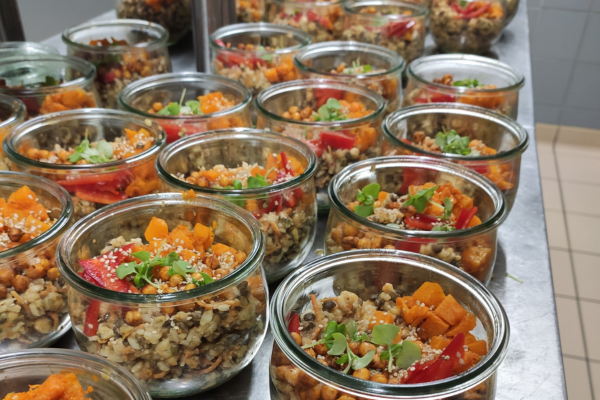
Our platters are packaged in reusable glass jars: we deliver, collect, wash and put these containers back into circulation. Zero waste is at the heart of our approach: stainless steel cutlery, glass verrines for buffets, no disposable crockery. Even our recipes are designed with these constraints in mind, which become a source of creativity for us.
We also offer cocktail buffets for larger events, catering for artists in Dijon (L'Écrin, Le Cèdre), as well as coffee and sweet breaks. Another of our solutions: a connected fridge installed in a Dijon business, which enables us to offer our jars on a self-service basis - a concept we intend to develop further.
The company was born out of a professional reconversion, and now has five employees. We started out in the Dijon Sud area before moving our laboratory to Avenue de Stalingrad in Dijon. We work exclusively to order, with no physical store.
Our values are strong and committed:
These commitments shape Ciboulette's DNA: to offer healthy, responsible and inventive cuisine, without compromising on taste or values.
How did you come to contact the CTCPA? What were your needs? What were your objectives?
One of the great advantages of the glass jar we use at Ciboulette is that it can be vacuum-packed, which significantly extends the shelf life of meals. It's a real asset for better organizing our production, anticipating needs, and being more fluid in the kitchen.
But despite initial shelf-life tests carried out with the Côte-d'Or departmental laboratory, we needed more in-depth support. After a year and a half of testing, we wanted to go further: refine analyses, make processes safer, and above all, optimize every stage - from cooking to washing to cooling. Hygiene is one of our cornerstones.
Our offer is based on our menus, which change every week, so it's impossible to test recipe by recipe. So we had to create coherent product families, define the right shelf lives, and make sure everything held up microbiologically.
It was against this backdrop that Carla LUCET, who had already ordered meal trays from us as part of training courses run at the CTCPA site in Dijon, referred me to the microbiology laboratory at the CTCPA in Avignon. She put me in touch with Lwidgi LUGROS, Head of the laboratory, who helped us structure our approach: product classification, selection of bacteria to be analyzed, definition of thresholds. Thanks to this expert advice, we were able to launch a new analysis campaign that was much more precise and adapted to our operations.
Why did you choose the CTCPA? How did you hear about the CTCPA?
I discovered the CTCPA when I was setting up my project, at a time when I was incubating at the T incubator, a structure supported by France Active Bourgogne. Carla was also a member of the jury and attended the final presentation of our projects. That's when I first heard about the CTCPA, initially as an analysis laboratory.
Afterwards, we kept in touch with Carla, particularly after she had ordered meals from us for her training courses. These exchanges gave us food for thought: beyond its analytical role, the CTCPA could undoubtedly provide us with more in-depth support, with a real consultancy dimension.
It was this positioning that convinced me to call on them. I wasn't just looking for a laboratory to provide factual results, but a partner capable of helping us to progress, structure our approach and deepen our understanding of microbiological issues.
What I also appreciated was the CTCPA's organization: with several specialized centers throughout France and experts in a wide variety of fields, they are able to adapt to specific needs and provide comprehensive solutions. This makes the CTCPA a relevant and reliable partner for structures like ours, which are in the throes of restructuring and in need of expert technical support.
How did the support go?
The support began with preparatory discussions with Carla and Lwidgi. The aim was to set the scene, introduce them to our concept and kitchen practices, and in particular to enable Lwidgi - who knew us less well - to fully understand how we operated. I therefore provided him with a number of data in advance, so that he could analyze our situation and prepare his recommendations.
Once these elements had been assimilated, we organized an hour-long videoconference. Lwidgi presented me with the results of his research, as well as his advice on the next steps to be taken, in particular the analyses to be carried out to refine our approach.
At the end of this exchange, I received a detailed report covering all our discussions. This document serves as a reference for me, a valuable written basis to which I can refer over time. In the meantime, I also asked a few additional questions, extending the follow-up slightly.
Overall, I was very satisfied with the support I received. The discussions were clear, structured and enriching. I was able to gain a better understanding of how microbiological analyses work, thanks in particular to the discovery of the national grids used as a reference by specialized organizations. These grids specify the bacteria to look for according to product families, which enabled us to better categorize our preparations.
This detailed understanding has helped us to interpret analysis results more calmly - whether they are good or more problematic - and above all to identify concrete avenues for improvement in the event of non-compliance.
In the end, this support enabled us to confirm that we were on the right track, while refining our protocol. We integrated new, more targeted microbiological analyses, which I passed on to the departmental laboratory, making our monitoring more effective.
This gives us real peace of mind when it comes to the quality and hygiene of the products we offer. It's reassuring to be surrounded by professionals who are available, competent and ready to listen, capable of providing us with concrete, actionable answers to optimize our practices.
What is your assessment today? How are the benefits of this support manifesting themselves? What are your next objectives or announcements?
The results are very positive. The CTCPA's support has enabled us to gain a better understanding of the microbiological aspects of our products, and to strengthen our analyses, particularly with regard to shelf life. This year, our aim was to relaunch all analyses linked to shelf life, with the ambition of extending them, while ensuring food safety.
This work was carried out in a context of transition: we moved into a new laboratory designed according to our methods. This meant that we had to be even more rigorous about hygiene, and the CTCPA's support gave us reliable benchmarks with which to move forward serenely.
To date, our four product families have been validated, with a few days' shelf life gained. We have a better understanding of analysis results and know how to react in the event of an anomaly. The departmental laboratory also supports us, which reinforces our progress.
Looking ahead, demand is growing, and we're already planning a larger, better-equipped laboratory, for which further support from the CTCPA would be most welcome. At the same time, our catering service continues to expand!
Our priority remains to reconcile environmental requirements, quality and economic viability. We're proving that it's possible, even if it requires a lot of hard work and rigor.
__
CONTACT Ciboulette - Le Goût du Local :
"Overall, I was very satisfied with the support I received. The discussions were clear, structured and enriching. I was able to gain a better understanding of how microbiological analysis works."
Introduce us to CIBOULETTE - LE GOÛT DU LOCAL: structure, vision, values, products...
Ciboulette - Le Goût du Local is a Dijon-based company founded in March 2021, specializing in catering services for professionals: companies, associations, local authorities, with a core business centered on cocktail buffets and tray meals for meetings, seminars and training courses. We also provide occasional services for private events, often on a referral basis.
Our platters are packaged in reusable glass jars: we deliver, collect, wash and put these containers back into circulation. Zero waste is at the heart of our approach: stainless steel cutlery, glass verrines for buffets, no disposable crockery. Even our recipes are designed with these constraints in mind, which become a source of creativity for us.
We also offer cocktail buffets for larger events, catering for artists in Dijon (L'Écrin, Le Cèdre), as well as coffee and sweet breaks. Another of our solutions: a connected fridge installed in a Dijon business, which enables us to offer our jars on a self-service basis - a concept we intend to develop further.
The company was born out of a professional reconversion, and now has five employees. We started out in the Dijon Sud area before moving our laboratory to Avenue de Stalingrad in Dijon. We work exclusively to order, with no physical store.
Our values are strong and committed:
- Local, with products sourced from producers located within a 50 km radius of Dijon (fruit, vegetables, meats - beef, pork -, pulses, flour and eggs). For products that can't be found locally (pasta, rice, dried goods), we use the services of a French organic cooperative based in the south of France.
- Organic as much as possible, but without compromising proximity. We always give priority to quality local produce.
- Zero waste, with a maximum limitation on single-use packaging, and the use of reusable jars and cutlery.
- Anti-waste, by adding value to ingredients (asparagus stalks transformed into cream, strawberry peelings into syrup), and redistributing unsold products via Too Good To Go or HopHopFood.
These commitments shape Ciboulette's DNA: to offer healthy, responsible and inventive cuisine, without compromising on taste or values.
How did you come to contact the CTCPA? What were your needs? What were your objectives?
One of the great advantages of the glass jar we use at Ciboulette is that it can be vacuum-packed, which significantly extends the shelf life of meals. It's a real asset for better organizing our production, anticipating needs, and being more fluid in the kitchen.
But despite initial shelf-life tests carried out with the Côte-d'Or departmental laboratory, we needed more in-depth support. After a year and a half of testing, we wanted to go further: refine analyses, make processes safer, and above all, optimize every stage - from cooking to washing to cooling. Hygiene is one of our cornerstones.
Our offer is based on our menus, which change every week, so it's impossible to test recipe by recipe. So we had to create coherent product families, define the right shelf lives, and make sure everything held up microbiologically.
It was against this backdrop that Carla LUCET, who had already ordered meal trays from us as part of training courses run at the CTCPA site in Dijon, referred me to the microbiology laboratory at the CTCPA in Avignon. She put me in touch with Lwidgi LUGROS, Head of the laboratory, who helped us structure our approach: product classification, selection of bacteria to be analyzed, definition of thresholds. Thanks to this expert advice, we were able to launch a new analysis campaign that was much more precise and adapted to our operations.
Why did you choose the CTCPA? How did you hear about the CTCPA?
I discovered the CTCPA when I was setting up my project, at a time when I was incubating at the T incubator, a structure supported by France Active Bourgogne. Carla was also a member of the jury and attended the final presentation of our projects. That's when I first heard about the CTCPA, initially as an analysis laboratory.
Afterwards, we kept in touch with Carla, particularly after she had ordered meals from us for her training courses. These exchanges gave us food for thought: beyond its analytical role, the CTCPA could undoubtedly provide us with more in-depth support, with a real consultancy dimension.
It was this positioning that convinced me to call on them. I wasn't just looking for a laboratory to provide factual results, but a partner capable of helping us to progress, structure our approach and deepen our understanding of microbiological issues.
What I also appreciated was the CTCPA's organization: with several specialized centers throughout France and experts in a wide variety of fields, they are able to adapt to specific needs and provide comprehensive solutions. This makes the CTCPA a relevant and reliable partner for structures like ours, which are in the throes of restructuring and in need of expert technical support.
How did the support go?
The support began with preparatory discussions with Carla and Lwidgi. The aim was to set the scene, introduce them to our concept and kitchen practices, and in particular to enable Lwidgi - who knew us less well - to fully understand how we operated. I therefore provided him with a number of data in advance, so that he could analyze our situation and prepare his recommendations.
Once these elements had been assimilated, we organized an hour-long videoconference. Lwidgi presented me with the results of his research, as well as his advice on the next steps to be taken, in particular the analyses to be carried out to refine our approach.
At the end of this exchange, I received a detailed report covering all our discussions. This document serves as a reference for me, a valuable written basis to which I can refer over time. In the meantime, I also asked a few additional questions, extending the follow-up slightly.
Overall, I was very satisfied with the support I received. The discussions were clear, structured and enriching. I was able to gain a better understanding of how microbiological analyses work, thanks in particular to the discovery of the national grids used as a reference by specialized organizations. These grids specify the bacteria to look for according to product families, which enabled us to better categorize our preparations.
This detailed understanding has helped us to interpret analysis results more calmly - whether they are good or more problematic - and above all to identify concrete avenues for improvement in the event of non-compliance.
In the end, this support enabled us to confirm that we were on the right track, while refining our protocol. We integrated new, more targeted microbiological analyses, which I passed on to the departmental laboratory, making our monitoring more effective.
This gives us real peace of mind when it comes to the quality and hygiene of the products we offer. It's reassuring to be surrounded by professionals who are available, competent and ready to listen, capable of providing us with concrete, actionable answers to optimize our practices.
What is your assessment today? How are the benefits of this support manifesting themselves? What are your next objectives or announcements?
The results are very positive. The CTCPA's support has enabled us to gain a better understanding of the microbiological aspects of our products, and to strengthen our analyses, particularly with regard to shelf life. This year, our aim was to relaunch all analyses linked to shelf life, with the ambition of extending them, while ensuring food safety.
This work was carried out in a context of transition: we moved into a new laboratory designed according to our methods. This meant that we had to be even more rigorous about hygiene, and the CTCPA's support gave us reliable benchmarks with which to move forward serenely.
To date, our four product families have been validated, with a few days' shelf life gained. We have a better understanding of analysis results and know how to react in the event of an anomaly. The departmental laboratory also supports us, which reinforces our progress.
Looking ahead, demand is growing, and we're already planning a larger, better-equipped laboratory, for which further support from the CTCPA would be most welcome. At the same time, our catering service continues to expand!
Our priority remains to reconcile environmental requirements, quality and economic viability. We're proving that it's possible, even if it requires a lot of hard work and rigor.
__