Regulations, food safety

Regulatory change regarding Listeria monocytogenes criteria in ready-to-eat foods

17

Mar

Regulatory change regarding Listeria monocytogenes criteria in ready-to-eat foods

Published on: 17/03/2025

We wish to inform you of an important change in the regulations concerning ready-to-eat foodstuffs (category 1.2 of Regulation (EC) No. 2073/2005). The new regulation (EU) 2024/2895, which came into force on December 11, 2024, will apply from July 1, 2026.


What's new :


- Previous regulations: Regulation (EC) no. 2073/2005 (1)



- New regulations: Regulation (EU) 2024/2895 (2)
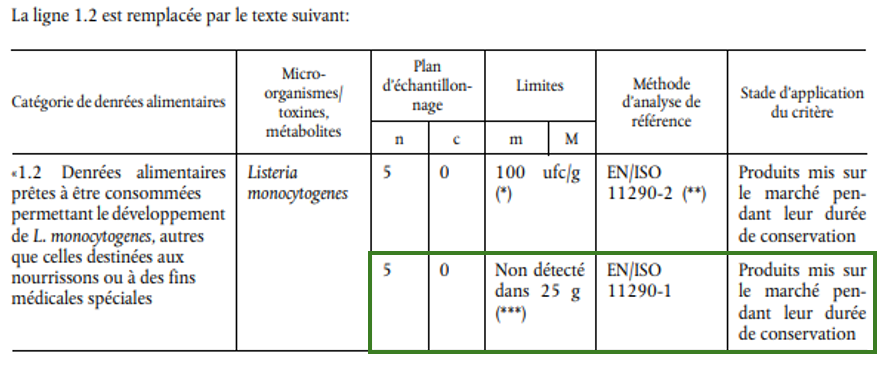

For products where Listeria monocytogenes can grow, the manufacturer must now demonstrate, to the satisfaction of the competent authority, that the 100 CFU/g limit is respected until the end of the shelf-life. If this proof is not provided, the product must meet the strict criterion of not detected in 25 g.


Products concerned :


Ready-to-eat (RTE) foods that support the growth of Listeria monocytogenes, (with the exception of products for infants and foods for special medical purposes). Either :
- Smoked fish
- Cold cuts
- Certain unpasteurized dairy products / raw milk cheeses
- Certain prepared salads (containing seafood, for example)


Adapting practices :

Food industry operators have until July 1, 2026 to comply with the new requirements.
Various tools are available to validate and/or verify the shelf life of a RTE product. They are listed in the regulations and in particular in the DGAL's technical instruction (DGAL/SDSSA/2024-270):
- Challenge tests: Experimental contamination to monitor the evolution of Listeria monocytogenes.
- Predictive microbiology: mathematical models to predict bacterial behavior.


References:
1) Regulation (EC) No. 2073/2005 – initial European text defining microbiological criteria applicable to foodstuffs, including MAP.
2) Regulation (EU) 2024/2895 – recent update strengthening the requirements for the control of Listeria monocytogenes and specifying the application throughout the shelf life of products.
3) Instruction DGAL/SDSSA/2023-27 – specifies the categorization of MAP/non-MAP products and the physicochemical criteria used to determine growth potential.
4) Instruction DGAL/SDSSA/2024-270 – details the methods and tools (challenge tests, predictive microbiology) for demonstrating compliance with the new criteria and adapting control plans.

Our microbiology laboratory in Avignon can provide these services. The CTCPA is a member of the Sym'Previus scientific interest group (GIS).


For more information, please contact us at: microbiologie.contact@ctcpa.org

Spread the love

latest news

11

May

Version 7 of the FSSC 22000 standard was released on May 1, 2026: what’s new?

The FSSC 22000 standard is evolving with the release of Version 7, which takes effect on May 1, 2026. This new version includes several major changes aimed at strengthening food safety, aligning with GFSI requirements, and addressing sustainability issues. Learn about the key changes and the transition timeline to expect.

Read more

The FSSC 22000 standard is evolving with the release of Version 7, which takes effect on May 1, 2026. This new version includes several major changes aimed at strengthening food safety, aligning with GFSI requirements, and addressing sustainability issues. Learn about the key changes and the transition timeline to expect.

06

May

The microbiology laboratory at the CTCPA in Avignon has received COFRAC accreditation for stability testing!

The CTCPA microbiology laboratory in Avignon is COFRAC-accredited for stability testing in accordance with standards NF V08-401 and NF V08-408. It assists food industry manufacturers in managing microbiological risks and optimizing food safety.

Read more

The CTCPA microbiology laboratory in Avignon is COFRAC-accredited for stability testing in accordance with standards NF V08-401 and NF V08-408. It assists food industry manufacturers in managing microbiological risks and optimizing food safety.

06

May

Innovation: The CTCPA is supporting the Isautier Group in the development of its new line of canned beverages!

The CTCPA supported the Isautier Group in developing its new line of canned beverages: Isautier Fizz. We spoke with Louise Bouilloux, Head of Innovation, Research & Development.

Read more

The CTCPA supported the Isautier Group in developing its new line of canned beverages: Isautier Fizz. We spoke with Louise Bouilloux, Head of Innovation, Research & Development.

latest news

Training

11

May

Version 7 of the FSSC 22000 standard was released on May 1, 2026: what’s new?

Published at 8:23 a.m.

The FSSC 22000 standard is evolving with the release of Version 7, which takes effect on May 1, 2026. This new version includes several major changes aimed at strengthening food safety, aligning with GFSI requirements, and addressing sustainability issues. Learn about the key changes and the transition timeline to expect.

Read more

Microbiology

06

May

The microbiology laboratory at the CTCPA in Avignon has received COFRAC accreditation for stability testing!

Posted at 3:05 p.m.

The CTCPA microbiology laboratory in Avignon is COFRAC-accredited for stability testing in accordance with standards NF V08-401 and NF V08-408. It assists food industry manufacturers in managing microbiological risks and optimizing food safety.

Read more

Customer testimonials

06

May

Innovation: The CTCPA is supporting the Isautier Group in the development of its new line of canned beverages!

Posted at 12:31 p.m.

The CTCPA supported the Isautier Group in developing its new line of canned beverages: Isautier Fizz. We spoke with Louise Bouilloux, Head of Innovation, Research & Development.

Read more

This will close in 0 seconds