
Partners, sectors & events

MYPACK European project: the final conference will take place on February 2, 2022

26

Jan
MYPACK European project: the final conference will take place on February 2, 2022

Published on : 26/01/2022

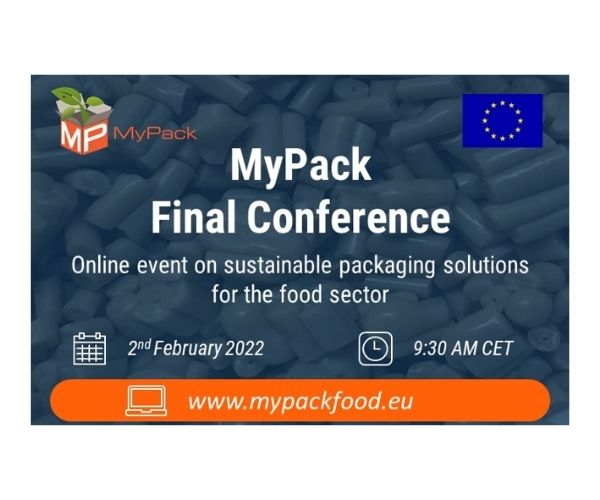
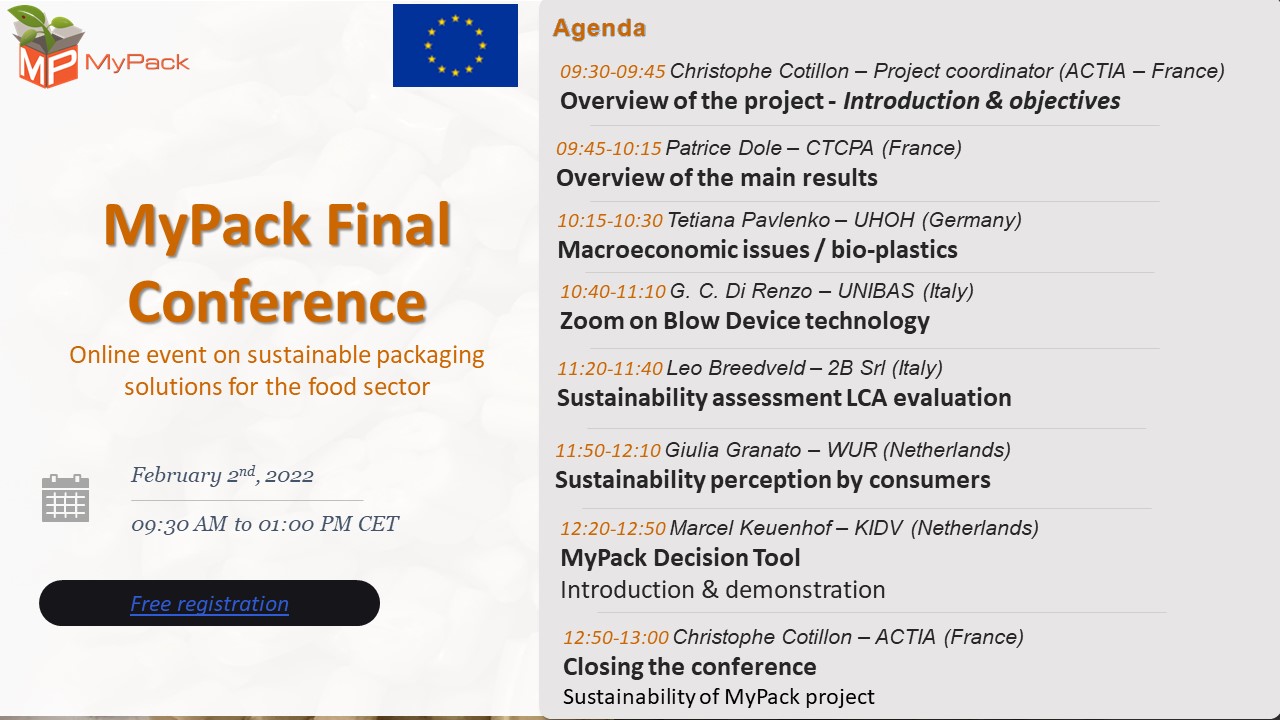
The final conference of the European project MYPACK will take place on February 2, 2022. Registration is now open!

REGISTRATION


Image

MyPack "Best markets for the exploitation of innovative sustainable food packaging solutions is a four-year project started on November 1, 2017 and funded by the Horizon 2020 program (Grant Agreement Number 774265).

MyPack's objective is to support the introduction of innovative packaging to the market in order to reduce waste and its negative influence on the environment. In the 27 European countries, 89 million tons of food waste are produced every year, which means that Europeans throw away 20% of the food they buy.

Packaging waste is also produced by the ton, and the recovery rate varies between 50 and 98%; the recycling rate is between 50 and 79%.

An important parameter for the evaluation of packaging is its optimal impact on the environment. For such a concept to be successful, consumers must also be involved. Information, awareness and dissemination of benefits are key elements.

Therefore, MyPack aims to include the various expectations of different consumer groups regarding sustainability, handling, safety and product quality in the project. A new package can be adapted to many different consumer expectations. MyPack strives to find the best possible products and the best possible market for the commercial development of new packaging technologies.

More information and updates on project activities are available on the MyPack website and social media channels:

Contact CTCPA : Patrice DOLE - pdole@ctcpa.org
Spread the love

latest news

07

Jul

An Update on Clostridium: Current Food Safety Issues

Bacteria of the genus Clostridium pose a major food safety concern due to their ability to form highly resistant spores and, in the case of certain species, to produce toxins that cause foodborne illnesses, some of which can be severe.

Read more

Bacteria of the genus Clostridium pose a major food safety concern due to their ability to form highly resistant spores and, in the case of certain species, to produce toxins that cause foodborne illnesses, some of which can be severe.

07

Jul

From Data to Environmental Labels: The Role of Agribalyse®, InCyVie, and Ecobalyse®

Environmental labeling of food products is set to play an increasingly important role in the strategies of agri-food companies.

Read more

Environmental labeling of food products is set to play an increasingly important role in the strategies of agri-food companies.

07

Jul

NIAS: What Are the Challenges for Food Safety?

Unintentionally Added Substances (UAS) are a growing concern for manufacturers of materials intended to come into contact with food.

Read more

Unintentionally Added Substances (UAS) are a growing concern for manufacturers of materials intended to come into contact with food.

latest news

Regulations, food safety

07

Jul

An Update on Clostridium: Current Food Safety Issues

Posted at 10:03

Bacteria of the genus Clostridium pose a major food safety concern due to their ability to form highly resistant spores and, in the case of certain species, to produce toxins that cause foodborne illnesses, some of which can be severe.

Read more

Industrial and environmental transition

07

Jul

From Data to Environmental Labels: The Role of Agribalyse®, InCyVie, and Ecobalyse®

Posted at 9:40 a.m.

Environmental labeling of food products is set to play an increasingly important role in the strategies of agri-food companies.

Read more

Packaging

07

Jul

NIAS: What Are the Challenges for Food Safety?

Posted at 9:33 a.m.

Unintentionally Added Substances (UAS) are a growing concern for manufacturers of materials intended to come into contact with food.

Read more

This will close in 0 seconds